
Lungo Coffee Cup Buying Guide: Capacity and Headroom
Reading time: about 9 minutes
A longer coffee pour can make a compact cup feel crowded fast. We see this in our store when shoppers choose by appearance alone, then realize their usual pour leaves little room below the rim. For a lungo coffee cup, listed capacity matters, but it is only half of the decision. The remaining space after you pour, usually called headroom, is what makes a cup feel comfortable to carry from the kitchen counter to an office desk.
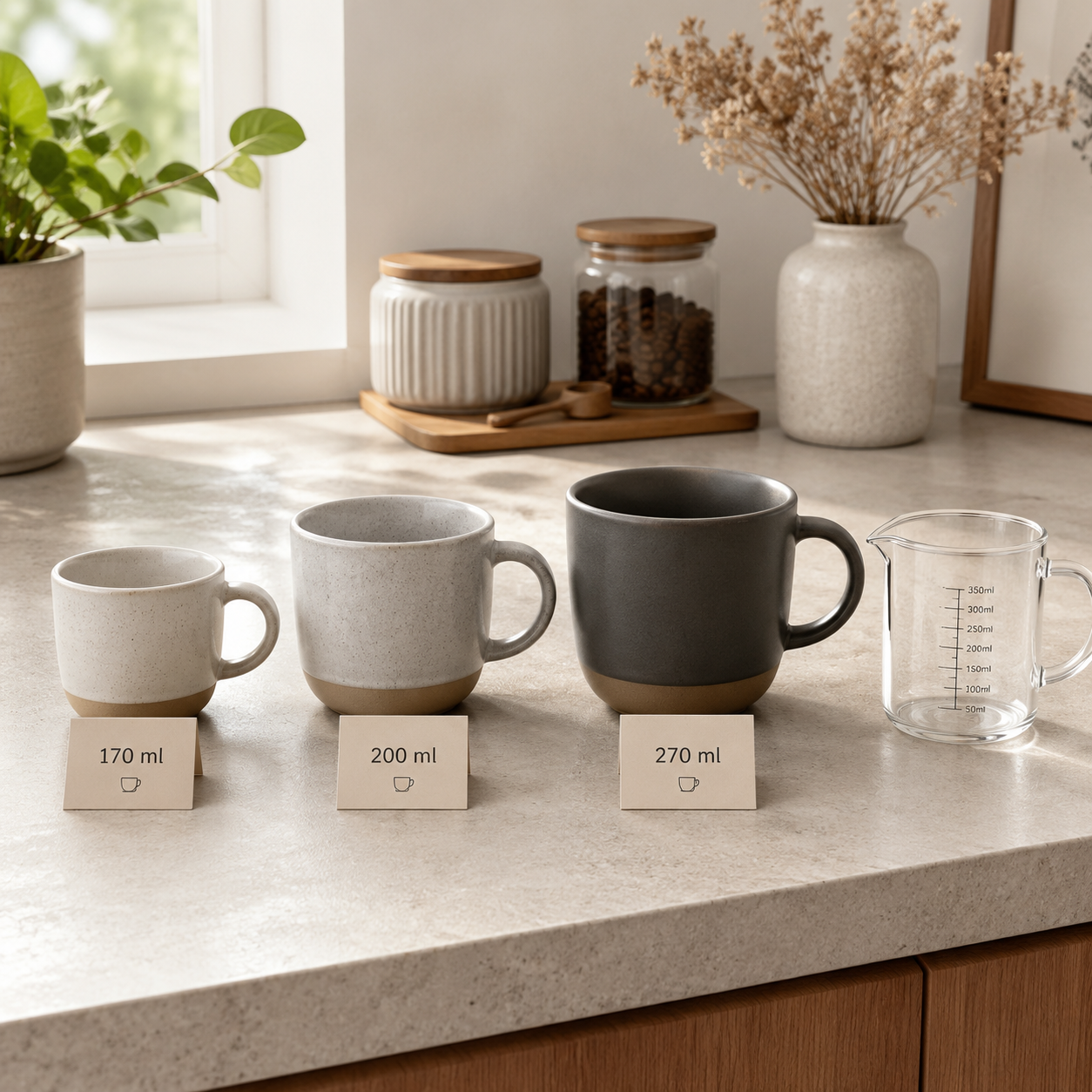
CoffeifyMug currently offers three relevant listed capacities in this compact-lungo-cups group: 170 ml, 200 ml, and 270 ml. Those numbers give you a clear starting point. They do not, however, tell us the exact physical space between a particular fill level and the rim, because product dimensions and fill lines are not listed. That limitation is worth stating plainly before you buy.
Why does a lungo coffee cup need headroom for a longer pour?
Headroom is the unused space at the top of the cup after you add your chosen amount of coffee. It is practical, not decorative. More unused capacity makes a fuller cup less awkward to move, especially when you are walking across a kitchen, setting it beside a keyboard, or handing it to someone during a busy morning.
Listed capacity is typically the maximum amount the vessel can hold, so it should not automatically be treated as your ideal fill level. A cup can technically hold its stated amount yet still feel too full for your normal routine. That is why we encourage shoppers to start with the amount they actually pour, then select capacity with some spare room rather than selecting a cup based solely on its visual size.
The trade-off is equally real. Extra capacity can be useful for a longer pour and more open space at the top, but it can also mean a larger object on a small desk or shelf. A compact option may suit someone who values a smaller footprint, provided their usual pour leaves enough room for comfortable handling.
170 ml, 200 ml, or 270 ml: which listed capacity fits your pour?
The three choices are close enough that it helps to compare them directly. The right selection depends on your intended fill amount and how much space you prefer to leave below the rim.
| Option | Listed capacity | Best starting point for | Main trade-off |
|---|---|---|---|
| Retro Coffee Tea Cup | 170 ml | A compact routine and a shorter selected fill amount | Offers the least unused capacity of the three for the same pour |
| Pleated Coffee Tea Cup | 200 ml | Shoppers seeking a moderate step up from a compact cup | Only 30 ml more listed capacity than the 170 ml option |
| Emerald Coffee Tea Mug | 270 ml | Longer pours or buyers who want the most capacity in this group | May be more capacity than a deliberately compact routine requires |
The Retro Coffee Tea Cup has a listed 170 ml capacity. It is the sensible place to start if your priority is keeping the cup compact and you already use a modest fill amount. It is not the strongest option for someone who fills close to the top or wants generous spare room for carrying a longer pour.
At 200 ml, the Pleated Coffee Tea Cup gives you a middle position. That 30 ml increase over the Retro option may be enough for a buyer whose current cup feels only slightly tight. It is not a dramatic jump in capacity, so shoppers wanting visibly more room should compare it honestly with the 270 ml option instead of assuming any larger number will solve the issue.
The Emerald Coffee Tea Mug has the largest listed capacity at 270 ml. For the same actual pour, it provides the greatest amount of unused capacity among these three choices. It is the more suitable pick for someone who dislikes a near-rim fill, but it is not necessary for every compact coffee routine.
How should you read capacity when rim shape and dimensions are not listed?
Capacity is a useful comparison measure, but it does not reveal every detail of how a cup feels when full. Exact headroom depends on the cup's internal shape, rim diameter, and the level at which you stop pouring. Since those measurements and a recommended fill line are not listed for these products, we would not claim a precise headroom figure for any of them.
Use the capacity comparison for what it can reliably tell you: 270 ml has 70 ml more listed capacity than 200 ml, and 100 ml more than 170 ml. If you put the same amount of coffee in each cup, the larger listed capacity leaves more capacity unused. It cannot tell you the exact distance from liquid to rim.
For a more informed purchase, measure your normal pour at home in a measuring jug. You do not need laboratory precision. Knowing the approximate amount you actually use is more helpful than guessing from a product photo. This is also useful for gift buying: capacity is a concrete detail you can match to the recipient's daily habit, while perceived size in an image is less dependable.
For a wider view of cup proportions and daily-use trade-offs, our unique coffee mugs collection lets you compare other styles after you have identified the capacity range that makes sense for you.
Which CoffeifyMug cup fits a compact desk or roomier counter routine?
A buyer working at a small desk usually has different priorities from someone serving coffee at a spacious kitchen table. Capacity should follow the situation, not a vague idea of what a lungo cup ought to look like.
- For a compact desk setup: Start with the 170 ml Retro Coffee Tea Cup if your chosen pour is modest and you value the smallest listed capacity. Its limitation is straightforward: there is less room to spare if you prefer a fuller cup.
- For a middle-ground everyday choice: Consider the 200 ml Pleated Coffee Tea Cup. It suits a shopper who wants more listed capacity without moving all the way to the largest option. Check your actual fill amount first, because the difference from 170 ml is limited.
- For a longer pour with more unused capacity: Choose the 270 ml Emerald Coffee Tea Mug. It is the clearest option in this group for buyers who want the most listed room. It may not suit a person who specifically wants the smallest possible cup on a crowded surface.
We also recommend separating a coffee decision from an iced-drink decision. A 170 ml cup is not a strong match if your normal serving includes a substantial amount of ice and you expect open space at the top. In that case, choose based on the total amount you intend to put in the cup, not the coffee alone. Our guide to coffee large cups for daily use and bigger pours is a useful comparison point if you are deciding between a compact lungo format and a larger everyday vessel.
What should you check before buying a cup for daily longer pours?
Capacity is the first filter, but a practical purchase takes one more minute of checking. These steps prevent the common mismatch between a cup that looks right online and one that feels wrong in daily use.
- Measure your usual fill amount. Use a measuring jug once, particularly if your current cup often feels too full.
- Choose how much spare room you want. If you routinely carry coffee around the house or across an office, avoid selecting a capacity that matches your fill amount too closely.
- Review the exact product listing. Confirm the listed capacity for the specific item rather than relying on a collection image or a similar-looking cup.
- Check care information on the product page. Do not assume dishwasher use or other care instructions based on a product title or a different item. Follow the listed guidance for the cup you buy.
- Inspect the item on arrival. Before first use, check the rim and base for any shipping damage. This is especially worthwhile for a gift unboxing, when there may be less time to arrange an exchange before the occasion.
Shoppers who are still deciding between coffee cup and mug proportions may also find our coffee cup and mug buying guide useful. It expands the comparison beyond capacity while keeping the decision focused on real daily use.
Frequently asked questions
What capacity lungo coffee cup should I choose for a longer pour?
Choose capacity by measuring the amount you normally pour, then allow room below the rim for your preferred headroom. Among these CoffeifyMug options, 170 ml is the smallest listed capacity, 200 ml is the middle choice, and 270 ml provides the most listed capacity. A larger number is not automatically better if you prefer a compact cup.
Does a 270 ml cup leave more headroom than a 170 ml cup?
For the same actual fill amount, the 270 ml option leaves more unused capacity than the 170 ml option. The precise physical headroom cannot be stated from capacity alone because internal dimensions, rim shape, and fill lines are not listed. Use the capacity difference as a reliable comparison, not as an exact measurement from liquid to rim.
Is a 170 ml cup too small for a lungo coffee?
It may be too small if your selected pour approaches 170 ml or if you want substantial room at the top. It can be appropriate for a more compact routine and a lower fill amount. Measure your normal serving before deciding rather than relying on a standard drink volume.
Which CoffeifyMug option has the largest listed capacity?
The Emerald Coffee Tea Mug has the largest listed capacity of these three choices at 270 ml. The Pleated Coffee Tea Cup is listed at 200 ml, and the Retro Coffee Tea Cup is listed at 170 ml. For buyers choosing primarily for unused capacity after a longer pour, the Emerald option is the direct next step.
Should I buy a lungo coffee cup as a gift?
Yes, if you know the recipient's preferred serving size or can ask what they use now. Capacity is a more dependable gift criterion than trying to estimate scale from photos. For an uncertain recipient, compare the 170 ml, 200 ml, and 270 ml options and select the size that best matches their usual coffee routine.
Before placing your order, write down your usual fill amount, decide how much room you want below the rim, and compare it against the 170 ml, 200 ml, and 270 ml listings. Then browse the CoffeifyMug unique coffee mugs collection to select the capacity and style that best match your counter, desk, or gift plan.
More from our blog
Read more

Loose Leaf Tea Mug Buying Guide: Capacity, Opening, Everyday Use
Compare CoffeifyMug's 250, 390, and 400 ml drinkware by listed capacity, visible opening, infuser-fit questions, cleanup, desk use, and gifting. The linked mugs do not include brewing filters or ac...
En savoir plus
Peppermint Tea Mug Buying Guide: Capacity and Daily Comfort
Compare 400 ml, 440 ml, and 480 ml peppermint tea mug options for the amount you actually pour and the comfort you need at home or at your desk. Use this guide to choose a size that suits your dail...
En savoir plus
Laisser un commentaire
Ce site est protégé par hCaptcha, et la Politique de confidentialité et les Conditions de service de hCaptcha s’appliquent.