
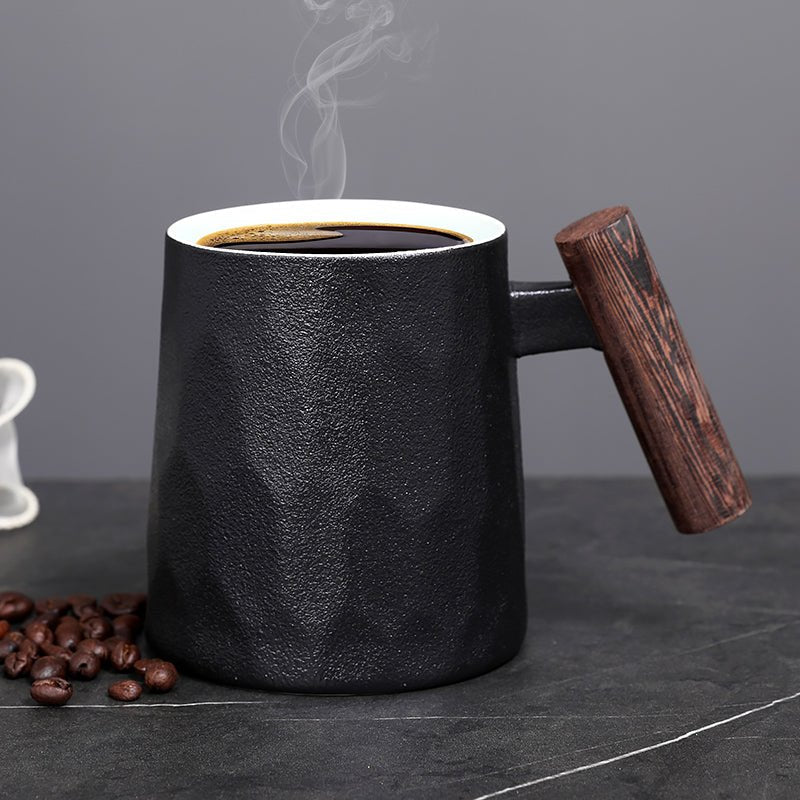
cafe au lait mug for small coffee setup: Size and Fit
Reading time: about 9 minutes
A mug can fit comfortably under your coffee maker and still be awkward everywhere else. We see the problem most often on narrow kitchen counters, shallow shelves, and office desks where the handle competes with a laptop, milk pitcher, or the mug beside it. Choosing a cafe au lait mug for small coffee setup therefore involves more than selecting the largest capacity available.
Our current comparison starts with three clearly listed capacities: The Flow at 400 ml, Morning and Night at 440 ml, and The Rock at 480 ml. Those numbers give you a useful starting point, but they do not describe the complete footprint. Shape, handle projection, cabinet clearance, and the amount of coffee and milk you normally pour all affect which mug will be easiest to live with.
In our experience selling mugs, buyers are happier when they measure the storage space first and treat extra capacity as a trade-off rather than an automatic upgrade. Here is how to compare these three choices without making unsupported assumptions about their construction or care requirements.
Which cafe au lait mug for small coffee setup takes the least planning?
Among these options, the 400 ml The Flow coffee and tea mug has the lowest listed capacity. That does not prove it has the smallest external dimensions, because two mugs with different wall profiles and handles can occupy similar shelf space. It does mean you are starting with 40 ml less capacity than Morning and Night and 80 ml less than The Rock.
That smaller listed volume can make sense for someone who prepares a moderate coffee-and-milk drink, uses a narrow section of counter, or wants less mug to maneuver around a keyboard. If your serving already comes close to 400 ml, however, it leaves less room for stirring and carrying without reaching the rim.
Before ordering, measure three separate clearances rather than relying on one cabinet dimension:
- Vertical clearance: Measure from the shelf surface to the shelf or cabinet frame above it.
- Body clearance: Measure the usable shelf depth and the width available for each mug body.
- Handle clearance: Allow for the full span from the far side of the mug to the outside edge of its handle.
- Working clearance: On the counter, leave enough room to lift the mug without striking the machine, wall, or another cup.
If you are still deciding among styles, browse the unique coffee mug collection and compare visible body and handle shapes against the space you measured. Capacity should narrow the field, while the listing photos help you judge the actual profile.
How much difference do 400 ml, 440 ml, and 480 ml make?
A 40 ml step may sound minor, but it can matter if your usual drink already fills most of a mug. Milk, foam, and stirring space all use capacity. At the same time, buying more volume than you use can leave you storing and handling a larger mug for no practical gain.
| Mug | Listed capacity | Difference from 400 ml | Situation it may suit |
|---|---|---|---|
| The Flow | 400 ml | Baseline | A moderate serving where lower listed capacity is the priority |
| Morning and Night | 440 ml | 40 ml more | A middle option for added pouring room without choosing the highest capacity |
| The Rock | 480 ml | 80 ml more | A larger coffee-and-milk serving or more room below the rim |
The 440 ml Morning and Night coffee and tea mug occupies the middle of the range. It is the practical comparison point for shoppers who find 400 ml restrictive but do not automatically need the largest option. The extra 40 ml may provide more comfortable stirring or carrying room, depending on your recipe.
The 480 ml The Rock coffee and tea mug offers the highest listed capacity of the three. It is the more relevant choice for a larger serving or for someone who deliberately leaves headroom below the rim. The limitation is straightforward: greater capacity does not guarantee a good fit on a shallow shelf or crowded desk, so check the product photos and available dimensions before treating volume as the deciding factor.
Why can handle shape matter more than capacity on a narrow shelf?
Handles create hidden footprint. A mug body may sit neatly in a row while its handle forces the next mug several centimeters away or catches the cabinet frame as you lift it. In a small setup, that projection can determine whether three mugs fit on a shelf or only two.
Handle comfort is also personal. A shopper who uses two or three fingers may prefer a different opening and grip position from someone who holds a filled mug with the whole hand. Capacity alone cannot tell you how the mug will feel once the weight of the drink is added.
We recommend checking the listing images for these practical details:
- Look at where the handle joins the body and how much space appears inside the opening.
- Compare the outside edge of the handle with the widest point of the mug body.
- Notice whether the body appears straight-sided, tapered, or wider near the base.
- Consider how the handle orientation will affect neighboring mugs on your shelf.
- Picture the filled mug beside the objects that already share your desk or counter.
If shelf stability is your main concern, our comparison of wide-bottom coffee mugs for small setups covers the separate trade-off between base width and usable storage space. A wider stance may feel useful on a work surface, but it can reduce the number of mugs that fit side by side.
Which capacity fits a kitchen counter, office desk, or milk-heavy drink?
The right choice changes with the location. On a kitchen counter, height and handle clearance around the coffee maker may be the limiting factors. At an office desk, overall width and the distance between the mug and electronics usually deserve more attention. Inside a cabinet, repeatable placement matters because an awkward handle position becomes annoying every morning.
Match the situation to the capacity rather than choosing by name alone:
- Compact counter and moderate serving: Start with The Flow at 400 ml. Its lower listed capacity is the logical first comparison when you do not need the extra 40 ml or 80 ml.
- One mug for several everyday drinks: Consider Morning and Night at 440 ml. It provides a middle capacity for shoppers balancing serving room against a constrained setup.
- Larger coffee-and-milk preparation: Compare The Rock at 480 ml. It offers the most listed volume, but confirm that its visible shape and handle work in your storage area.
- Very shallow or tightly packed shelf: Do not decide from capacity alone. Compare the product images and any dimensions shown on the live listings.
If your serving size is closer to a smaller standard mug, the guide to 12 oz ceramic coffee mugs for compact setups may be a more useful starting point. Shoppers preparing a coffee-and-chocolate drink can also compare the capacity discussion in our mocha mug guide for small coffee setups.
What is a larger cafe au lait mug not good for?
A 440 ml or 480 ml mug is not automatically the best choice for someone who pours a much smaller serving. Unused capacity still has to be stored, lifted, and positioned. A larger mug can also be inconvenient if you have a low shelf, a crowded workstation, or a coffee maker with limited clearance.
These mugs are also not the right purchase if you need guaranteed stackability. A mug can have a useful shape without being designed to nest securely with another. Do not assume that matching capacities or similar-looking rims make mugs stackable.
Buyers who need a specific material, appliance compatibility, or care method should verify those points on the current product listing or packaging before purchase and use. We do not infer those features from capacity, appearance, or the coffee-and-tea mug name. A different style is the better choice if one of those requirements matters more than serving volume.
What should you inspect when the mug arrives?
A brief inspection catches practical issues before the mug becomes part of your daily setup. Place it on a flat, dry surface and check that the base sits as expected. Look along the rim, examine the handle attachment points, and confirm that the item matches the capacity and design ordered.
Then test placement while the mug is empty. Put it under or beside your coffee maker, on its assigned shelf, and in the exact desk position you plan to use. Turn the handle to your normal gripping side. This simple check reveals conflicts with cabinet frames, walls, nearby mugs, and work equipment before you prepare a drink.
Follow the care information supplied with the current listing or product packaging. Mug capacity does not establish a care method, and visual appearance is not reliable evidence for one.
Frequently asked questions
What capacity is practical for a cafe au lait mug for small coffee setup?
Start with the volume you actually pour, then add enough room for milk, stirring, and carrying. The Flow is listed at 400 ml, Morning and Night at 440 ml, and The Rock at 480 ml, giving you three clear capacity steps to compare.
Is a 480 ml mug too large for a small kitchen?
Not necessarily, but capacity does not reveal the complete external footprint. A 480 ml mug is worth considering for a larger serving if its body, height, and handle fit your measured shelf and counter space.
Does the 40 ml difference between The Flow and Morning and Night matter?
It can matter when your normal drink approaches the rim of a 400 ml mug. The additional 40 ml may provide more room for milk or stirring, but it may be unnecessary if your serving is comfortably below 400 ml.
How do I compare mug handles before buying online?
Use listing photos to examine the opening, attachment position, and distance between the handle edge and mug body. Compare that visible profile with your available shelf width and consider how many fingers you normally place through the handle.
Should I choose the biggest mug to avoid spills?
Extra headroom can make stirring and carrying easier, but the biggest mug is not always the best fit. Choose the lowest capacity that comfortably holds your normal preparation while fitting the counter, shelf, and grip you use every day.
A short checklist before you order
- Write down your normal total serving volume, including coffee and milk.
- Compare that amount with the listed 400 ml, 440 ml, and 480 ml capacities.
- Measure vertical shelf clearance, shelf depth, and side-to-side space.
- Allow for the handle, not just the mug body.
- Check current listing photos for body and handle shape.
- Choose 400 ml for the lower-capacity starting point, 440 ml for the middle option, or 480 ml for the most listed room.
- Confirm any care or material requirement on the live product page rather than assuming it from appearance.
Take those measurements to the CoffeifyMug unique coffee mug collection, then compare The Flow, Morning and Night, and The Rock against the space you actually use. The best next step is the mug that clears your shelf, suits your grip, and holds your regular drink without paying a daily space penalty for capacity you do not need.
Read more
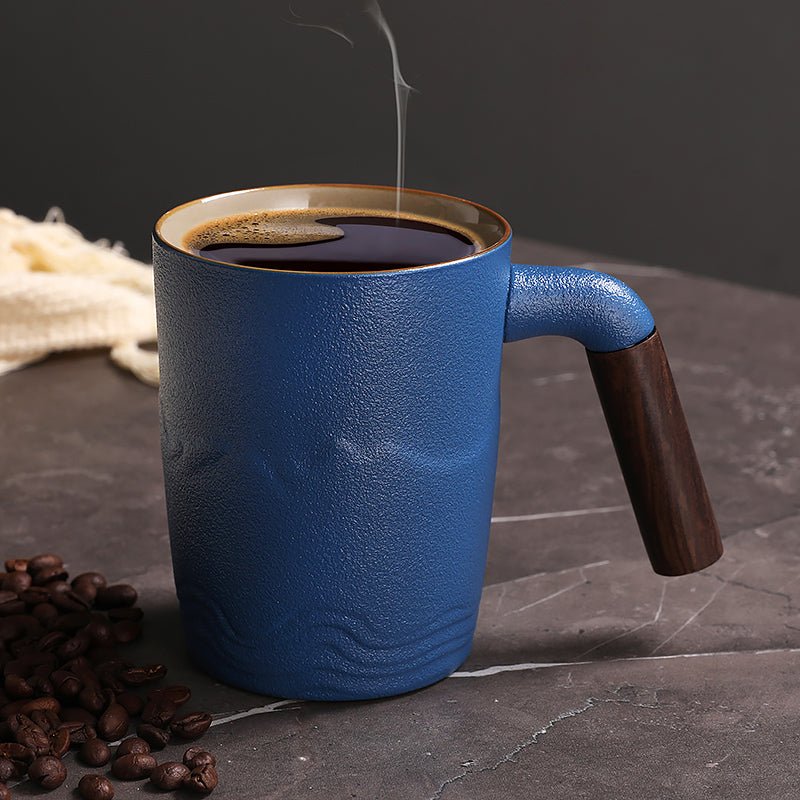
Clay Pottery Coffee Mugs for Desk Use: Fit Before You Buy
Compare desk-space needs, refill patterns, handle clearance, fired-clay care, and the current fit of three CoffeifyMug listings before choosing a mug.
En savoir plus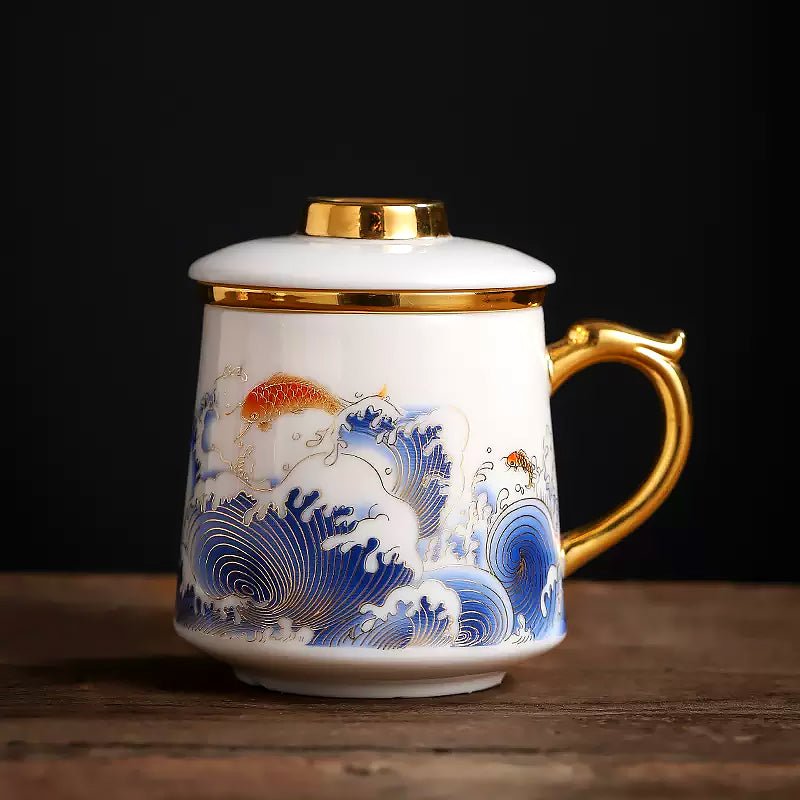
Ceramic Glazed Coffee Mugs for Small Coffee Setup: Key Checks
Compare 400, 440, and 480 ml glazed ceramic mugs by usable capacity, cabinet footprint, handle clearance, finish, and care needs. See how CoffeifyMug's current styles fit compact counters, desks, a...
En savoir plus
Laisser un commentaire
Ce site est protégé par hCaptcha, et la Politique de confidentialité et les Conditions de service de hCaptcha s’appliquent.