
Coffee Mug Racks Wall: How to Choose One That Fits Daily Use
Reading time: about 11 minutes
The cabinet door opens, two handles catch each other, and the mug you want scrapes the shelf on the way out. That small irritation is usually what sends shoppers looking at coffee mug racks wall options in the first place. A good wall rack frees useful counter space and keeps everyday mugs easy to grab. A bad one leaves you with crowded hooks, chipped glaze, or hardware that starts to loosen once real life sets in.
In our store, we spend a lot of time handling mugs, checking handle shapes, and hearing what customers like and regret after a few weeks of daily use. Open wall storage can look great, but it has to work on a rushed weekday morning too. If you want to compare rack ideas against mugs you would actually display, start with our full collection and look closely at body width, handle opening, and how coordinated you want the final setup to feel.
Do coffee mug racks wall solve the right problem for your space?
A wall rack works best when it solves a specific storage bottleneck. In smaller kitchens, that often means clearing the stretch of counter where the grinder, scale, or milk frother already fights for room. In office coffee corners, it keeps the shared mugs visible instead of buried on a shelf where rims knock together and nobody can tell what is clean.
It is not automatically the best answer, though. Open storage asks you to accept more visibility, more dust, and more attention to placement. If the only free wall is above a stovetop, mugs will pick up grease faster. If the rack would sit on a narrow walkway, protruding handles become a bump hazard. And if most of your drinkware is made up of tall travel tumblers rather than classic coffee mugs, a wall rack is simply the wrong tool.
- Best fit: four to eight everyday mugs used near the same coffee station every week.
- Less ideal: oversized novelty mugs, soup mugs, insulated tumblers, or delicate gift pieces that you do not want exposed.
- Most useful: shoppers who want quicker access and less cabinet crowding, not just extra decor.
- Worth skipping: rentals where drilling is off the table and adhesive hardware is the only option for heavy ceramic mugs.
We have found that the happiest buyers treat a wall rack as part of their coffee workflow, not as filler for an empty patch of wall. If the mugs on the rack are the same ones you wash, dry, and reach for again tomorrow, the setup usually earns its place. If the cups are mostly seasonal or sentimental, cabinet storage is often the smarter choice.
Which rack materials and hook shapes hold up best?
The material matters more than most shoppers expect. The weak point on a mug rack is often not the main rail. It is the threaded hook, the weld, the finish where ceramic rubs every day, or the screw placement at the wall. We see the fewest complaints with two styles: a hardwood rail with properly installed metal hooks, or a heavier steel rack with rounded hook ends and solid mounting points.
Hardwood rails tend to look warmer in home coffee bars, especially with natural cabinets or wood shelves nearby. They also hide small scuffs better than thin painted wire. Powder-coated steel is usually easier to wipe down around steam, coffee splatter, and damp mugs straight from the dishwasher. Unfinished or lightly sealed wood needs a little more care, because repeated moisture around the hook base can leave marks over time.
| Rack style | Why shoppers choose it | What to watch for |
|---|---|---|
| Hardwood rail with steel hooks | Warmer look, easy to pair with home coffee stations, often better visual contrast with ceramic mugs | Check for straight hook alignment, clean pilot holes, and no splitting around the screws |
| Powder-coated steel rack | Simple wipe-down care, clean lines, better resistance to routine splashes and steam | Inspect welds, hook smoothness, and finish quality where handles will rub |
| Shelf with hooks underneath | Adds room for beans, filters, or framed art above the mugs | Needs more wall depth and stronger mounting because the load pulls farther outward |
| Adhesive wall strip with hooks | No drilling, faster setup, appealing for temporary spaces | Not a strong long-term choice for heavy ceramic mugs or humid kitchen walls |
Hook design matters just as much as the main material. A rounded hook with enough depth to catch the handle securely is gentler than a short peg or sharply bent wire. Tight, shallow hooks are where trouble starts. Thick mug handles do not seat fully, the cup leans forward, and you end up removing the mug at an awkward angle every morning. Common failure points are practical ones: thin wire bending, paint chipping where glaze rubs, welds cracking on bargain racks, and screws loosening in soft drywall.
How much clearance do you need between hooks, mugs, and the counter?
This is where a rack that looks great online can become frustrating in a real kitchen. Capacity claims are often optimistic. Many are based on slim cups, not the broader 11 to 15 ounce ceramic mugs most people actually use for coffee.
As a starting point, we like to see about 4 inches of side-to-side room per standard mug and roughly 5 to 6 inches of vertical drop so the cup can lift on and off the hook without scraping the wall or counter. Wider hand-thrown mugs, big rounded stoneware, and extra-generous handles usually need more room than that. If a product photo shows mugs packed tightly shoulder to shoulder, assume daily use will feel tighter than the photo suggests.
- Measure the mug body. Check the widest point, not just the rim diameter. Rounded bodies take up more space than straight-sided shapes.
- Measure handle projection. A mug can look compact from the front and still need extra room because the handle sits far away from the body.
- Check vertical lift. You need enough clearance to raise the mug off the hook cleanly, especially if the rack sits above a backsplash or appliance.
- Check the room in front. A rack that projects too far can interfere with cabinet doors, espresso machine lids, or a busy walkway.
A simple tape test saves a lot of guesswork. Hold your widest mug where the rack would go and mark the top of the handle and the bottom of the mug with painter's tape. Then open the nearby cabinet doors, lift the water lid on the coffee machine, and pretend to remove the mug one-handed. We have seen plenty of installations that looked centered and tidy but failed the first time someone tried to refill a tank or reach under an upper cabinet.
Which mugs actually hang well on a wall rack?
The best wall-rack mugs have three things in common: a stable body, a comfortable open handle, and a finish you do not mind keeping on display every day. Tight decorative loop handles can be attractive, but they are less forgiving on shallow hooks. Very round mugs can push the whole row forward. Extra-heavy stoneware can work, but only if the rack and wall mounting are strong enough to handle daily use without wobble.
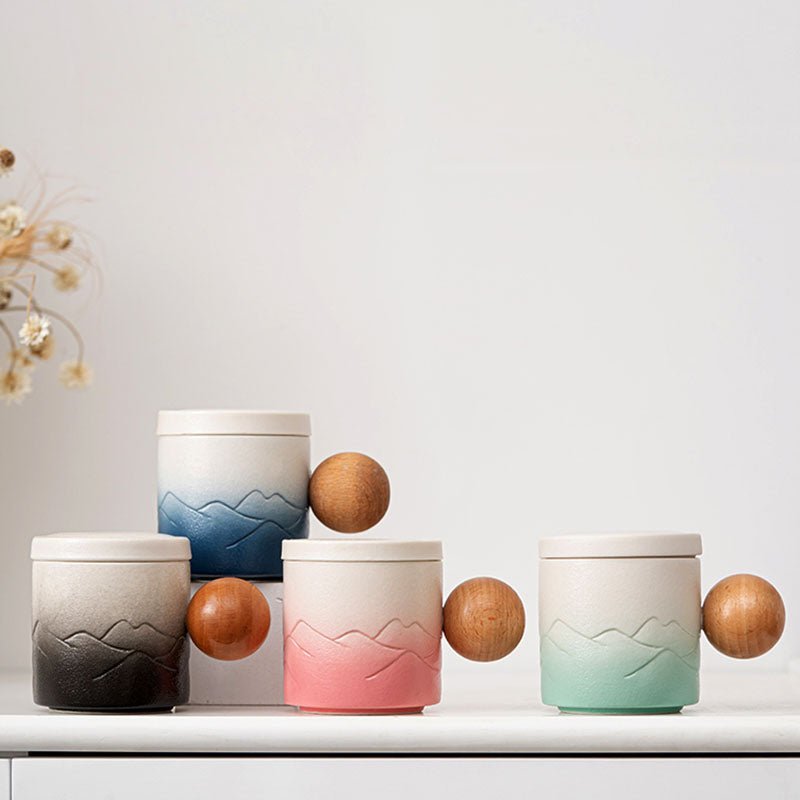
Open storage also changes the visual side of the decision. A rack usually looks better with a related shape or color story than with six completely unrelated mugs fighting for attention. If you are pairing the rack with mugs from our store, many shoppers compare the Mountain Coffee Tea Mug and the Great Mountain Coffee Tea Mug when they want the display to feel coordinated rather than random. If you want one richer accent in the row, the Emerald Coffee Tea Mug can add a stronger color note without changing the whole setup.
There are also mugs we would not push onto a wall rack. Tall travel tumblers store better upright. Delicate hand-painted pieces, double-wall glass, or sentimental gift mugs are safer in a cabinet. Jumbo soup mugs often look fun but crowd neighboring cups and can hang awkwardly if the handle angle is tight. Another practical detail people miss: if a mug comes out of the dishwasher warm and still damp, dry the handle first before rehanging it under wood or near painted metal hardware.
- Usually a good match: everyday ceramic coffee mugs, moderate-weight gift sets, and styles with open C-shaped handles.
- Usually a poor match: tumblers, oversized novelty pieces, fragile glass mugs, and anything you would hate to see bumped in a busy kitchen.
- Best visual result: mugs with a shared shape, theme, or color rhythm rather than a crowded assortment of one-offs.
Where should you mount the rack in a kitchen or office?
Closer to the coffee maker almost always beats prettier empty wall across the room. People use the rack more when the mug is one easy reach from the brewer, kettle, or sugar shelf. That said, close does not mean directly above heat or steam. Above a kettle vent, next to a greasy stovetop, or over a sink splash zone, the mugs will need more frequent cleaning and the rack itself will age faster.
Wall surface matters too. Drywall usually needs proper anchors unless you are hitting a stud. Tile can work well visually, but the drilling has to be done carefully and the stand-off from the wall needs to keep mug bottoms from tapping the hard backsplash. In office break rooms, we often like the rack a little higher than in home kitchens so handles stay clear of snack bins, paper cups, and the pile of odds and ends that collects under shared appliances.
- Mark the mug bottom line first. Do not center the rack by eye. Mark where the mug bottoms will land once they are hanging.
- Open everything nearby. Test cabinet doors, machine lids, and windows before you drill.
- Match hardware to the wall. A solid rack still fails if the mounting method is wrong for drywall, plaster, or tile.
- Load it gradually. Hang one or two mugs first, then check for tilt, wobble, and crowding before filling the whole rail.
Adhesive-only mounting deserves a realistic warning. It can be fine for a lightweight display in a dry, low-traffic spot. It is not our first choice for heavy ceramic mugs that are coming on and off the hooks every day. If drilling is not possible, a countertop tree or cabinet organizer may be the safer purchase.
What should you compare before you buy?
Style is the easy part. The better buying decision comes from matching the rack to your actual mug rotation, wall surface, and tolerance for open storage. A rack can look clean in a styled photo and still feel annoying if it blocks an upper cabinet, sticks too far into the room, or collects dust in a spot you already hate cleaning.
- Weekly use: Buy for the mugs you reach for now, not the full collection stored for guests.
- Hook depth: Compare the hook opening to your thickest handle, not your smallest mug.
- Projection from the wall: Make sure the mug body will not jut into a walkway or interfere with cabinet hardware.
- Finish care: Powder-coated metal is usually easier to wipe; raw or lightly finished wood needs gentler treatment around moisture.
- Wall limitations: Studs, drywall anchors, tile drilling, and rental rules should all shape the decision before checkout.
- Display goal: If the rack is visible all day, the mugs matter as much as the rack itself.
In our experience, the most common mistake is buying the rack first and trying to force favorite mugs into it later. If you know the mugs are part of the look as well as the storage solution, compare silhouettes across our collection before you commit. It is much easier to judge the right rack once you know what will actually hang on it.
Frequently asked questions
How far apart should hooks be on a mug rack?
For many standard ceramic coffee mugs, about 4 inches of side-to-side spacing is a good starting point. Wider mugs, thicker handles, and rounded bodies often need more room. If the rack image shows cups touching each other, expect a tighter fit in daily use than it appears online.
Can a wall rack hold heavy ceramic mugs?
Yes, if the rack is built well and mounted correctly for the wall surface. The real weak point is usually the mounting hardware or the wall anchor, not the mug. For heavier mugs, we prefer drilled mounting over adhesive-only options and we like hooks with enough depth that the handle sits securely.
How high should a mug rack sit above the counter?
There is no perfect single measurement because mug height, appliance clearance, and user reach all change the answer. The safest approach is to hang your tallest mug on a test hook position and make sure it clears the counter while still being easy to remove one-handed. Always check nearby cabinet doors and coffee machine lids before final installation.
Will mugs get dusty on an open wall rack?
Yes, more than they would behind a cabinet door. The trade-off for easy access and a cleaner coffee-station look is that mugs are exposed to dust, steam, and kitchen residue. In calmer areas that is minor, but near the stove or sink you will notice it faster.
What mugs should stay in the cabinet instead of on the wall?
Travel tumblers, delicate glass mugs, gold-rimmed gift pieces, heirlooms, and extra-wide oversized mugs are usually better off in enclosed storage. They are either awkward to hang, easy to bump, or too bulky for tight hook spacing. A wall rack works best with the cups you use often and do not mind keeping on display.
Set out the four mugs you use most, measure their body width and handle depth, and tape that footprint onto the wall before you order anything. If you want the storage choice and the visual choice to work together from day one, compare those dimensions against the mugs in our collection and choose the rack only after you know what will live on it.
More from our blog
Read more
Coffee Mug Display Rack Guide for Kitchens, Offices, and Small Spaces
A coffee mug display rack should do more than hold cups. We break down materials, fit, and placement so you can choose one that looks clean and works in a real kitchen or office.
Leer más
Coffee Mug Racks Wall: How to Choose a Space-Saving Rack
A wall mug rack can free up counter space fast, but the right one depends on mug weight, wall type, and how often you actually grab a cup. Here’s how we help shoppers choose a rack that looks good ...
Leer más
Dejar un comentario
Este sitio está protegido por hCaptcha y se aplican la Política de privacidad de hCaptcha y los Términos del servicio.