
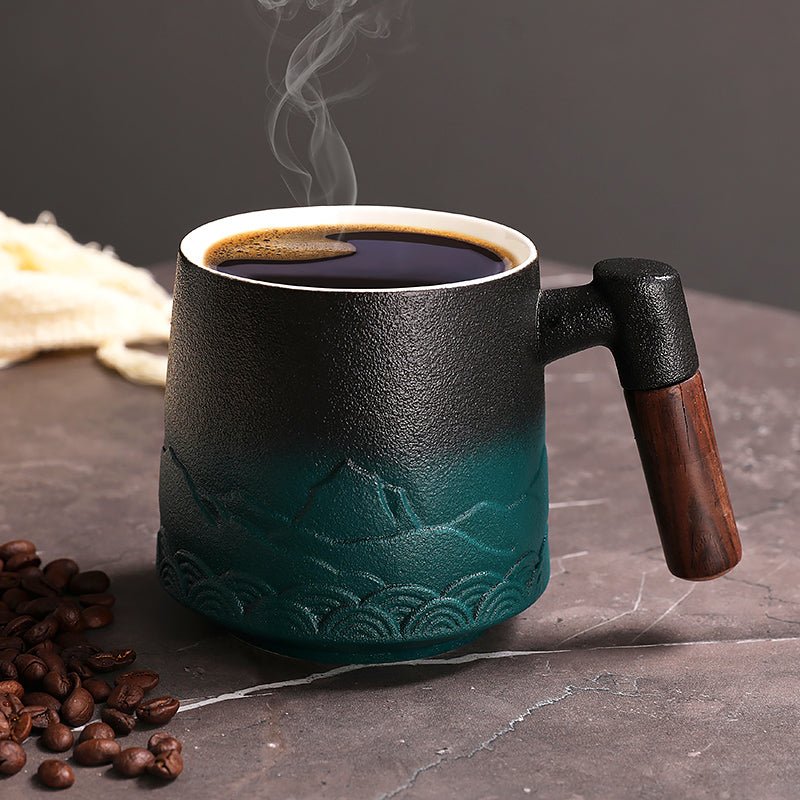
Coffee Mug Painting: What Works, What Fails, and What to Buy
Reading time: about 9 minutes
A painted mug usually looks great on the first day. The problem shows up later, often on the rim, the handle edge, or anywhere a dishwasher spray hits hard. In our store, that is the difference between a mug that still feels gift-worthy and one that starts looking tired after a few wash cycles.
If you are picking a blank to paint, start with a smooth base. Our All Coffee Mugs collection is the fastest way to compare shapes, and a few of our taller pieces, like the White Golden Waves Tall Coffee Tea Mug, Mountain Tall Coffee Tea Mug, and Handbag Coffee Tea Mug, are useful examples of how mug shape changes the painting surface.
For a broader materials breakdown, our post on Coffee Mug Painting: Materials, Methods, and What Holds Up covers the paint types and finish choices in more detail.
What mug surface gives the cleanest painted result?
The cleanest coffee mug painting results usually come from a smooth, glazed ceramic surface. That glossy finish gives you a consistent base, and it is easier to wipe down before you paint. Matte glazes can look attractive on the shelf, but they often grab brush strokes more visibly and can make fine lines look uneven.
We see three common surface types in practice:
| Surface | What it does well | Where it struggles |
|---|---|---|
| Glossy glazed ceramic | Even paint laydown, easier cleanup, cleaner edges | Can be slippery for some paints if you skip prep |
| Matte or textured glaze | Good for rustic looks and loose brushwork | Brush marks, uneven coverage, harder detail work |
| Deeply shaped or ribbed mug | Interesting visual shape | Wraparound art is harder to place and align |
If you want to paint a detailed scene, a straight-sided mug gives you the most predictable canvas. Tall mugs also help because you get more vertical space for a monogram, line drawing, or repeating pattern. That is one reason shoppers often prefer the tall format over short, rounded mugs for hand-painted work.
Trade-off: a beautiful sculpted mug can look better as a finished object, but it is usually worse as a painting surface. If the shape is already busy, your artwork has to work harder.
Which paints and markers actually hold up on a mug?
Not every paint that looks good on paper behaves well on ceramic. For coffee mug painting, the most reliable options are usually ceramic or porcelain paints, enamel-style paints, and paint pens made for slick surfaces. Regular craft acrylic can work for decorative use, but only if the product directions say it should be sealed and cured for that purpose.
Our rule in the store is simple: if the paint system does not clearly explain curing, sealing, and wash care, we treat it as a decorative finish rather than a daily-use finish.
- Ceramic or porcelain paint: best for a controlled finish and cleaner durability guidance.
- Paint pens: good for lettering, small icons, and thin outlines.
- Enamel-style paint: useful when you want a harder surface after full cure.
- Regular acrylic: fine for display pieces, but not our first choice for mugs that will be handled and washed often.
Our earlier guide, Coffee Mug Painting: Materials, Methods, and What Holds Up, walks through those trade-offs in more detail. The key point is that the paint matters as much as the mug.
We do not treat a painted mug as food-contact safe just because the outside looks sealed. Keep paint off the drinking rim and the interior unless the product and paint system are explicitly intended for that use.
That warning matters more than people expect. A mug can look finished and still be the wrong choice for daily coffee if the coating is not designed for heat, hand washing, and repeated handling.
How do you prep a mug before painting?
Prep is the part most people want to skip. It is also where most failures start. A mug that still has dust, packaging residue, or hand oils on the glaze gives paint less to grip, and that shows up later as beading, patchy coverage, or edges that lift first.
- Wash the mug with mild soap and water, then let it dry fully.
- Wipe the outside with isopropyl alcohol on a lint-free cloth.
- Mask the rim and the interior if you only want the exterior painted.
- Sketch lightly first if your design needs spacing or symmetry.
- Apply thin coats instead of trying to cover everything in one pass.
We also recommend checking the handle area before you start. Handles create awkward sight lines, especially on round mugs, and they are easy to forget when you rotate the cup while painting. A missed patch behind the handle is one of the most common spots people notice only after the mug is cured.
If you want to compare blank sizes before you paint, our 12 Ounce Coffee Mug Buying Guide for Daily Use and Better Fit is useful because size affects how much uninterrupted canvas you really have.
What designs are easiest to paint on a mug?
The best beginner designs are not the most complicated ones. They are the ones that still look clean after the mug has been turned, handled, and washed. In our experience, simple line art, small repeating motifs, bands, initials, and geometric shapes tend to age better than a highly detailed wraparound scene.
Tall mugs are especially good for vertical art. That is why a shape like the White Golden Waves Tall Coffee Tea Mug works well for a clean stripe, a plant stem, or a narrow illustration that follows the mug's height. The Mountain Tall Coffee Tea Mug is a similar example: the taller body gives you room for a centered design, but not so much width that the art gets stretched awkwardly.
The Handbag Coffee Tea Mug is a different case. It is fun and memorable, but the sculpted shape means your artwork has to work with the silhouette, not against it. That makes it better for a playful accent or a bold simple design than for precise symmetry.
- Best for beginners: initials, dots, stripes, minimal florals, simple faces, short text.
- Better for experienced painters: wraparound landscapes, fine lettering, layered scenes.
- Not ideal for: very dense patterns that need perfect alignment across the handle seam.
If your goal is a clean gift mug rather than a showpiece, keep the art readable from one side. That matters on a desk or kitchen counter, where most people only see one face of the mug at a time.
What usually makes painted mugs fail?
The failures are usually boring, not dramatic. Paint peels near an edge. A line rubs off where a thumb sits. A mug looks fine until the first hot wash or long soak. We see the same few mistakes over and over.
- Too much paint at once: thick layers crack or stay soft longer than expected.
- Skipping cure time: the finish may feel dry but still fail under heat or washing.
- Painting the rim: that area gets the most contact and is the worst place for uncertain coatings.
- Using the wrong sealer: not every sealant works on every paint system or surface.
- Dishwasher testing too early: one aggressive cycle can expose a weak finish fast.
This is where trust matters. A mug that is meant to be a decorative shelf piece is not the same thing as a mug that should go into a dishwasher every morning. If you need daily durability, choose a paint system that explicitly supports that use, or pick a finished design on a glazed mug instead of painting one yourself.
For shoppers comparing blank options, our product pages and size guides help set expectations before you start. Our 11 oz Coffee Mug: Size, Fit, and What to Check Before You Buy is a good companion read if you are deciding how much surface area your design really needs.
How should you care for a painted mug after it is finished?
Care is what keeps a painted mug from looking tired too soon. Even a well-made finish benefits from a little restraint. We tell customers to treat painted mugs more like a hand-finished object than like a basic kitchen cup.
- Hand wash with a soft sponge whenever possible.
- Avoid long soaks, especially if the paint system is only lightly sealed.
- Skip abrasive scrubbers on the painted area.
- Be cautious with microwaves if the design uses metallic paint or uncertain additives.
- Store the mug where it will not knock against other ceramics and chip the artwork.
That does not mean a painted mug is fragile by default. It means the finish has limits. If you want a mug that can move from office desk to sink to dishwasher without any thought, a painted mug is usually not the right choice. If you want a personal gift, a display piece, or a breakfast mug that gets gentler handling, a hand-painted finish can be a strong fit.
If you are still choosing the base mug, the All Coffee Mugs collection is the easiest place to compare shape, glaze, and size before you commit to a design.
Frequently asked questions
Can you use regular acrylic paint on a coffee mug?
You can use it for decorative projects, but we would not assume it is durable enough for daily washing unless the paint maker says it can be cured and sealed for ceramic use. Regular acrylic often looks fine on day one and then shows wear at the rim, handle, or high-touch areas. For a mug you want to use often, a ceramic or enamel-style product is the safer starting point.
Do painted mugs go in the dishwasher?
Only if the full paint system is explicitly rated for that use after proper curing. Even then, we still see hand washing preserve the finish better over time. If the mug is a gift or a one-off piece, hand washing is the practical choice.
What kind of mug is easiest for a beginner to paint?
A smooth, glossy, straight-sided ceramic mug is the easiest. It gives you a predictable surface, clear sight lines, and enough room for simple artwork without fighting curves or texture. Tall mugs are also helpful if you want a vertical design instead of a wraparound pattern.
How do you stop paint from peeling off a mug?
Start with a clean, fully dry mug, use a paint system made for ceramic, apply thin coats, and follow the cure instructions exactly. Most peeling starts with poor prep or rushed drying, not with the artwork itself. Keeping paint off the rim and interior also reduces wear.
Is a painted mug safe for hot coffee?
The coffee itself is fine, but the paint choice matters. Keep the design on the exterior and use only products intended for ceramic surfaces. If you are unsure about the coating, treat the mug as decorative rather than assuming it is food-contact safe.
If you are choosing a mug to paint next, compare three things before you buy: a smooth glazed surface, enough wall space for your design, and a shape that will not force the art around too many curves. Then start with our All Coffee Mugs collection and pick the blank that matches the kind of artwork you actually want to make.
Read more
Owl Coffee Mug Buying Guide: Size, Gift Value, and What to Check
An owl coffee mug should feel like a real daily cup, not just shelf decor. We cover the size, care, and gift details buyers actually check before they order.
Leer más
Santa Claus Coffee Mugs: What to Check Before You Buy
A Santa mug should do more than sit on a shelf. We break down size, handle comfort, finish, and care so you can choose one that gets used after the gift is opened.
Leer más
Dejar un comentario
Este sitio está protegido por hCaptcha y se aplican la Política de privacidad de hCaptcha y los Términos del servicio.