
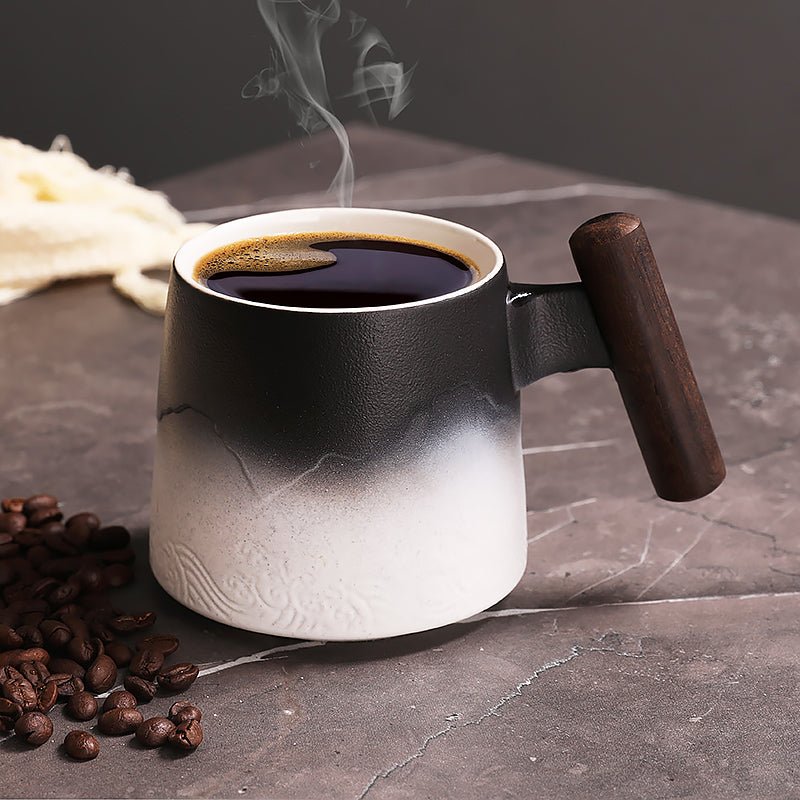
Coffee Mug Measurement Guide for Everyday Use and Better Fit
Reading time: about 9 minutes
A mug can look perfect in photos and still feel wrong once it reaches a kitchen cabinet or office desk. We see that most often with buyers who want a simple coffee mug measurement check before ordering: they need to know how much it holds, how wide it is, and whether it will fit their daily routine.
That is the part we try to make easy in our store. A coffee mug measurement is not just the advertised ounce count. Real use depends on the opening diameter, the height, the handle clearance, the wall thickness, and how much room the mug needs on a tray, coffee maker, or dishwasher rack.
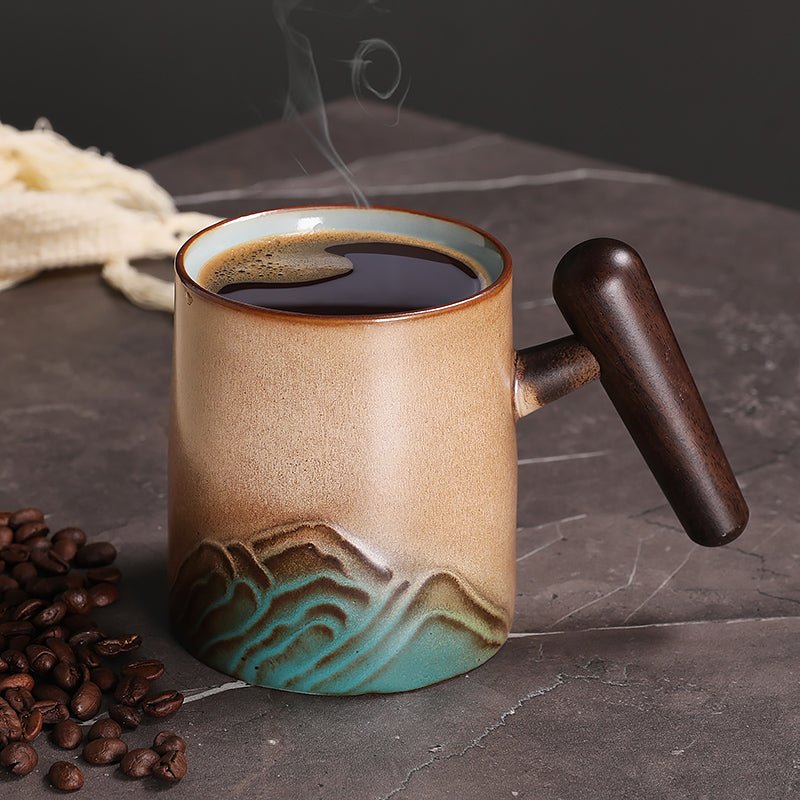
If you are comparing styles now, our full collection is a good place to start, and a few of our specific mugs show how shape changes the feel even when the capacity is similar. For example, the Christmas Coffee Tea Mug is a straightforward ceramic option for seasonal gifting, while the Green Waves Coffee Tea Mug and the Mountain Sea II Coffee Tea Mug with Wooden Handle show how design, handle style, and material choice affect daily comfort.
What does coffee mug measurement actually include?
Buyers often think measurement means only the printed capacity. That is part of it, but not the whole story. In our experience, the best fit comes from checking five numbers or traits before you buy:
- Capacity: usually listed in ounces or milliliters, and this is the amount the mug can hold under normal fill levels.
- Height: matters for shelves, coffee machines, and cabinets with low clearance.
- Top diameter: affects sipping comfort, steam release, and how wide the mug feels in the hand.
- Base width: important for mug warmers, tray stability, and narrow dishwasher racks.
- Handle opening: often overlooked, but it can decide whether a mug feels comfortable for larger hands or when wearing a ring.
That is why two mugs with the same volume can still feel very different. A shorter, wider mug usually feels more stable but can cool a drink faster. A taller mug may be better for small counters, yet it can be less balanced if the base is narrow.
How do you read mug ounces without guessing wrong?
Ounce labels are useful, but they can be misleading if you expect a mug to be filled to the rim. Most mugs are measured to a practical fill line, not the top edge. That means a 10 oz mug does not necessarily pour 10 oz of usable drinking space when you leave room for coffee, milk, foam, or tea leaves.
For shoppers trying to understand the differences between common sizes, our related guides on 10 oz coffee mug size and fit, 11oz coffee mug size, fit, and materials, and 12 oz coffee mug fit and daily use can help you compare the everyday differences more clearly.
Here is the practical rule we use when helping customers choose:
- For black coffee or tea, a smaller mug can feel more focused and easier to finish while it is hot.
- For milk drinks, a little extra headroom matters so the cup does not splash when stirred.
- For desk use, check height and stability before you check style.
- For gifting, a mug that feels comfortable to hold matters more than the biggest capacity on the page.
If you want one quick takeaway, do not buy by ounces alone. Match the number to the way you actually drink.
What mug size works best for coffee, tea, and desk use?
The best size depends on what lives in the cup most days. In our store, we see three common buying patterns. Some shoppers want a compact mug for daily drip coffee. Others want something a little larger for tea or latte-style drinks. A third group wants a decorative mug that still feels usable at a desk.
| Use case | What usually works | Why buyers choose it |
|---|---|---|
| Black coffee | Smaller to mid-size mug | Heats quickly, easy to finish before the drink cools |
| Tea or coffee with milk | Mid-size mug with room at the top | Less spill risk when stirring or adding milk |
| Office desk | Stable base, comfortable handle, moderate height | Fits near keyboards and monitor stands better |
| Gift mug | Balanced size and easy grip | Feels practical instead of oversized or novelty-only |
Our experience is that mugs around the 10 to 12 oz range are the easiest everyday fit for most shoppers, which is why we also built out comparison content like 11 oz coffee mug size and what to check before you buy and 12 ounce coffee mug buying guide. Larger mugs are useful too, but they are not always the best choice if your cabinet shelves are tight or your hand prefers a smaller handle.
Which physical measurements matter most before you buy?
We recommend checking the mug like you would check a new kitchen tool: by function, not just appearance. A beautiful mug with a cramped handle or an unstable base becomes a shelf piece fast.
- Height: measure against your cabinet shelf, coffee maker, or mug warmer.
- Opening width: a wider opening changes how fast a drink cools and how easy it is to sip while moving around the kitchen.
- Handle clearance: make sure your fingers fit comfortably, especially if the mug has a thick ceramic wall.
- Base diameter: narrow bottoms can feel tippy on crowded desks.
- Weight when empty: heavier ceramic feels solid, but it can be tiring if you carry it around all day.
We handle a lot of ceramic mugs, and one common issue we watch for is an uneven glaze line or a handle that looks generous in photos but feels tight in the hand. Another thing buyers miss is lip comfort. A slightly rolled rim tends to feel better for daily sipping than a sharp, thin edge.
The Christmas Coffee Tea Mug is a nice example of a classic ceramic mug style that suits gifting and seasonal use, while the Green Waves Coffee Tea Mug gives a more visual, decorative feel for a desk or kitchen shelf. If you prefer a more tactile grip, the Mountain Sea II Coffee Tea Mug with Wooden Handle adds a different handling experience that some buyers really like. It is not the best pick for someone who wants a fully uniform all-ceramic feel, though.
What material and care details should buyers check?
Material affects how the mug feels, how it wears, and how easy it is to keep clean. Most mugs in this category are ceramic, and ceramic is popular because it retains heat reasonably well, looks good on a counter, and handles everyday use without feeling too delicate. The trade-off is that ceramic can chip if it knocks against sinks, taps, or other mugs in the dishwasher.
We also look closely at finish and care expectations. A mug with a smooth glazed surface is typically easier to rinse and wipe down. If a mug includes a wooden handle, like the Mountain Sea II Coffee Tea Mug with Wooden Handle, that changes care a bit: the wood needs a gentler cleaning approach than a fully ceramic body. That style is not ideal if you want a mug you can toss into the dishwasher every day without thinking about it.
Before checkout, we suggest checking for these practical details:
- Finish: glossy glaze is easier to wipe clean than textured or heavily embossed surfaces.
- Handle type: ceramic handles feel more uniform; wooden handles can feel warmer and more natural but need different care.
- Dishwasher use: confirm whether the mug is intended for machine washing or hand washing.
- Microwave use: wooden components are generally not a microwave-friendly choice.
That last point matters. If your routine involves reheating coffee all morning, a simple ceramic mug is usually the safer choice than a mixed-material design.
How do you avoid the most common mug-buying mistakes?
Most returns we see in drinkware are not because the mug is badly made. They happen because the mug is not the right fit for the buyer’s routine. The easiest way to avoid that is to match the measurement to the use case before you place the order.
- Measure the cabinet space first. A mug can be the right volume and still not fit your shelf.
- Check the handle with your hand in mind. If you have larger hands, prioritize handle clearance over decorative shape.
- Think about the drink. Tea, espresso-based drinks, and drip coffee all reward different mug shapes.
- Consider cleaning habits. If you rely on the dishwasher, avoid styles that need special care.
- Judge by daily use, not display value. A decorative mug is still a working mug only if it is comfortable to use every day.
We also advise shoppers not to overbuy size. A larger mug is not automatically better. It can make a drink feel lukewarm before you finish it, and it takes more shelf space. On the other hand, a mug that is too small forces refills and can feel fussy during a workday.
Which mugs in our store make the best comparison starting points?
If you want to compare options side by side, these three are useful examples because they show different priorities. The Christmas Coffee Tea Mug is a straightforward ceramic gift mug. The Green Waves Coffee Tea Mug leans more decorative and is good for buyers who want something visually distinct on a desk or kitchen shelf. The Mountain Sea II Coffee Tea Mug with Wooden Handle stands out if a warmer, more natural grip is part of the appeal.
None of those is automatically the best for every shopper. The ceramic-only styles are easier for everyday dishwasher use. The wooden-handle style is better when grip and presentation matter more than one-step cleanup. If you are still undecided, browsing the full collection gives you a wider comparison point without guessing from size alone.
Frequently asked questions
How do I measure a coffee mug at home?
Use a measuring cup or kitchen scale if you want capacity, and a ruler or tape measure for height, mouth width, and base width. For a real-world check, fill the mug with water, then pour that water into a measuring cup to see the usable volume, not just the rim-to-rim estimate.
Is an 11 oz coffee mug big enough for daily use?
For many shoppers, yes. An 11 oz mug usually works well for drip coffee, tea, and smaller milk drinks, but it can feel a little small if you add a lot of milk or want a larger pour for desk use. If you want a more detailed comparison, our 11 oz guide helps with that decision.
What mug size is best for gifts?
A mid-size mug is usually the safest gift choice because it fits more routines and does not feel oversized. The best gift mug also has a comfortable handle and a shape that looks good sitting on a counter, not just in a photo.
Are wooden-handle mugs harder to care for?
Usually, yes. Wood changes the care routine because it does not belong in the microwave and may need gentler washing than a fully ceramic mug. If convenience is your top priority, a plain ceramic mug is usually easier to live with.
Why does my mug feel smaller than the listed ounces?
Because the listed capacity is usually a practical fill measure, not a rim-to-the-top overflow fill. Wall thickness, shape, and the amount of empty headroom you leave for safe sipping all reduce the amount you actually drink from it.
If you are choosing between a few styles, compare the capacity, height, opening width, handle comfort, and care routine first. Then pick the mug that fits the way you actually drink coffee or tea, not just the one with the biggest number on the page. For more options, start with our collection and then open the product pages that match your size and care preferences best.
Read more
3d Coffee Mug Buying Guide: What to Check Before You Buy
A practical guide to choosing a 3d coffee mug that looks good on the desk, holds up to daily use, and fits the way you actually drink coffee or tea. We cover real trade-offs, sizing, care, and whic...
Leer más
NASCAR Coffee Mug: What to Check Before You Buy
A nascar coffee mug should work on a kitchen counter, an office desk, and in a sink full of real dishes. We break down size, handle feel, care trade-offs, and what to check before you buy.
Leer más
Dejar un comentario
Este sitio está protegido por hCaptcha y se aplican la Política de privacidad de hCaptcha y los Términos del servicio.