
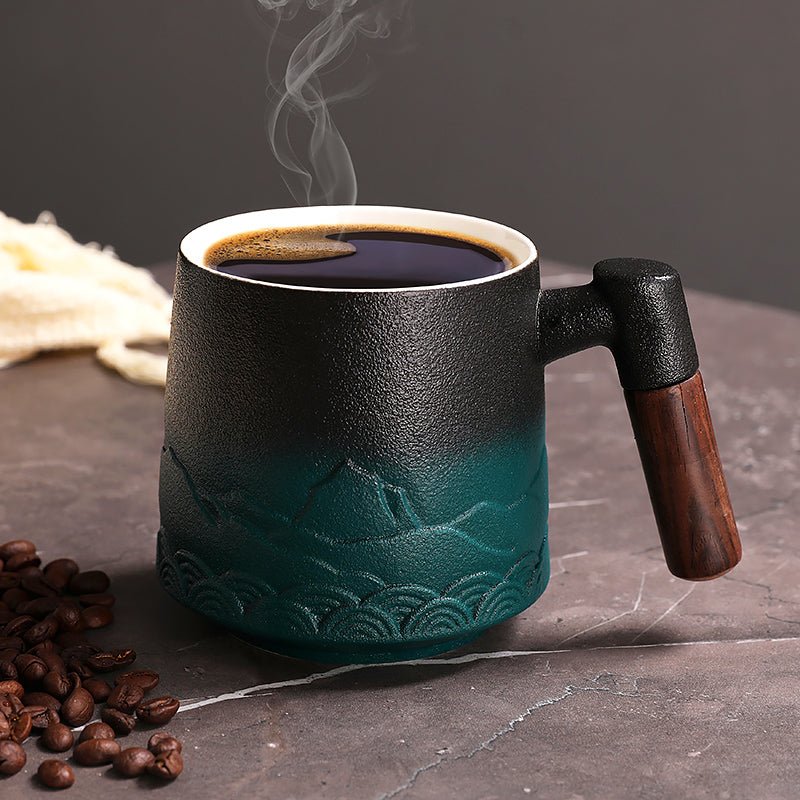
Coffee Mug Clay: What Buyers Should Check Before They Order
Reading time: about 9 minutes
A clay mug looks simple on a product page. On the counter, the details show up fast: a lip that feels rough, a handle that is a little too tight for two fingers, a base that leaves rings, or a glaze that does not hold up after repeated dishwasher cycles. We see those differences matter most after the first week of use, not the first sip.
That is why we treat coffee mug clay as more than a style choice. It is a daily-use decision. The right mug should feel balanced in hand, keep a drink comfortable for a few extra minutes, and survive the normal routine of a kitchen sink, office desk, and gift unboxing without fuss.
If you want to compare options while you read, start with our Koi Fish Coffee Tea Mug for a more decorative clay mug look, then browse the full collection to see what fits your style and cup size needs.
What does coffee mug clay actually mean for everyday use?
In practical terms, coffee mug clay usually means a mug made from a clay body such as stoneware or earthenware, then finished with a glaze. That construction affects weight, heat retention, chip resistance, and how the mug feels after a few dish cycles. It is not just about appearance.
In our store, we think about three things first: how the mug sits in the hand, how the rim feels against the lips, and how the surface finish behaves after daily washing. A good clay mug should have a smooth drinking edge, a stable base, and a glaze that covers the areas you actually touch. If those basics are off, the mug becomes annoying quickly.
Clay mugs are a strong fit for people who want a little more substance than a thin glass or light porcelain cup. They are less ideal if you want the lightest possible mug, the fastest heat loss, or a travel-ready vessel that needs a tight lid and maximum portability.
If you want a broader checklist before narrowing by style, our Clay Coffee Mug Buying Guide covers the core buying points we use when selecting mugs for our catalog.
Which clay body should you look for?
Most shoppers do not need a ceramics degree. They do need a quick way to sort the realistic choices. For a coffee mug clay purchase, the main decision is usually about the clay body and how it was finished.
| Clay type | What it feels like | Best for | Trade-off |
|---|---|---|---|
| Stoneware | Heavier, solid, and durable-feeling | Daily coffee, desk use, gift mugs | Usually less lightweight than finer cups |
| Earthenware | Warmer, often a bit more porous under the glaze | Decorative use and casual sipping | Can be more sensitive to chips if handled roughly |
| Porcelain-style clay body | Smoother and more refined in hand | People who want a cleaner, lighter feel | Can feel less substantial and more delicate |
For daily coffee at home, stoneware is usually the safest middle ground. It gives you a sturdy feel without becoming bulky. Earthenware can work well if the glaze and finish are well done, but it is the one we inspect more closely for chip-prone edges and base wear. If your household tends to stack mugs tightly in a cabinet, that matters.
Clay mugs with hand-finished surfaces can be especially appealing as gifts. The texture and artwork make them feel chosen, not generic. The trade-off is that decorative details can create small cleaning challenges, especially around raised patterns or textured handles.
For shoppers focused on use case and size rather than material alone, our Mug Coffee and Clay: What Buyers Should Check Before They Order is a practical companion read.
What details should you check before buying?
We recommend looking at the mug the way a kitchen drawer would: by stress points. That means handle, rim, base, glaze, and weight. Those are the places where a clay mug either feels well made or starts bothering you every day.
- Handle clearance: Make sure two fingers fit comfortably without scraping the mug body.
- Rim finish: The drinking edge should feel smooth, not sharp or uneven.
- Foot ring: A clean base reduces scratching on counters and helps the mug sit flat.
- Glaze coverage: Look for even coverage where the mug is touched most often, especially the handle and rim.
- Weight balance: A mug should feel stable when full, not top-heavy.
These details are what separate a good shelf piece from a mug you actually reach for every morning. We have seen buyers choose a beautiful mug, then stop using it because the handle pinches or the base feels rough on a desk surface. The photo does not always show that.
The Crane Coffee Tea Mug is a useful example of why the small details matter: a clay mug can be visually distinct without giving up everyday function, as long as the handle, rim, and glaze are well resolved.
Is a coffee mug clay mug good for hot drinks every day?
Yes, if you want a mug that feels substantial and holds heat a bit longer than very thin drinkware. Clay has more thermal mass than lightweight cups, so it tends to stay pleasant through a slow morning. That is useful at a kitchen table, on a work-from-home desk, or during a gift-opening moment when the coffee gets set down and picked up a few times.
That said, clay mugs are not the best choice for every use. If you want a cup that cools faster, travels well in a bag, or is built for one-handed commuting, a travel tumbler or insulated vessel is the better fit. Clay is also not ideal if you need something nearly unbreakable for camping, dorm life, or heavy daily transport.
Another practical limit: some handmade-looking clay mugs can be a little thicker at the lip. That can feel comforting to one buyer and too heavy to another. If you are sensitive to mouthfeel, pay close attention to rim photos and product descriptions before ordering.
Our rule is simple: if the mug looks good but would be annoying to wash, hold, or store, it is not the right mug for daily use.
How should you care for a clay coffee mug?
Care depends on the finish, but a sensible routine goes a long way. Even when a mug is listed as dishwasher safe, we still suggest treating the first few washes as a test period so you can watch for glaze changes, rough edges, or base wear.
- Rinse the mug soon after use so coffee or tea residue does not build up in texture lines.
- Use a soft sponge on glazed surfaces and avoid abrasive pads on decorative details.
- Let the mug dry fully before stacking it with other heavy pieces.
- Check the base occasionally for tiny chips, especially if you store it in a crowded cabinet.
- If the mug has visible texture or hand-applied artwork, wash the detailed areas by hand when practical.
That is the real-world trade-off with many clay mugs. They are meant to be used, but the better they are finished, the more likely you are to keep them looking good by not treating them like a cheap utility cup. If you want to avoid guessing, our product pages and care notes are there to help.
Which style should you choose for your kitchen or office?
The best clay mug depends on the setting. A desk mug and a display-worthy kitchen mug often do not need the same features.
For a home office: choose a mug with a comfortable handle, moderate weight, and a stable base so it does not feel awkward next to a laptop and notebook.
For a kitchen shelf: decorative glaze, artwork, and shape matter more, because the mug is part of the room as much as the drink routine.
For gifting: presentation matters. A clay mug with distinctive artwork feels more personal than a generic cup, especially if the recipient keeps visible mugs in an open cabinet.
For daily practical use: prioritize smooth glaze, easy cleaning, and a size that matches the amount you actually drink. If you regularly pour a smaller cup, a huge mug can become inconvenient and heavy.
The Landscape Coffee Tea Mug is a good example of a style-first mug that still needs the same functional checks as any other clay piece. Looks matter, but the use case decides whether it stays in rotation.
How do you compare clay mugs before checking out?
We suggest comparing mugs with a simple decision filter. It keeps the choice grounded in how you will actually use the mug rather than how it looks in isolation.
- Daily use: Will this mug be used every morning, or only occasionally?
- Grip: Does the handle look comfortable for your hand size?
- Finish: Is the glaze smooth where it matters most?
- Cleaning: Will you realistically hand wash it, or do you need easy dishwasher care?
- Role: Is this a desk mug, a display mug, or a gift?
If you want to compare a few more options after reading this, browse the full collection and compare the shapes side by side. We also recommend pairing this with size-focused reading like our 11 oz Coffee Mug: Size, Fit, and What to Check Before You Buy if you are deciding between a smaller everyday cup and a larger one.
Frequently asked questions
Is a coffee mug clay mug safe for hot coffee every day?
Yes, if the mug is properly glazed and made for drink use. The bigger question is comfort and durability, not just safety: you want a smooth rim, a stable base, and a finish that holds up to repeated washing. If the mug is decorative only, do not assume it is suitable for daily hot drinks.
What should I check first before buying a clay coffee mug?
Start with the handle, rim, and base. Those three areas tell you most of what you need to know about daily comfort and build quality. After that, check whether the mug suits your routine: dishwasher use, desk use, or gift presentation.
Are clay mugs dishwasher safe?
Some are, but not all. Even when a listing says dishwasher safe, hand washing can be the better choice for mugs with textured surfaces, detailed artwork, or delicate glaze finishes. If you plan to use the dishwasher regularly, look for a mug with a smooth, even exterior.
What size clay mug is best for coffee?
That depends on how much you actually drink at one time. A smaller mug is better if you like a shorter pour and easier handling, while a larger mug makes more sense for longer sipping or milk-heavy drinks. If you are comparing sizes, our mug-size guides can help you avoid buying a mug that feels too small or too heavy.
What is the downside of a clay coffee mug?
The main trade-offs are weight, fragility compared with insulated drinkware, and the possibility of rougher texture if the mug is not finished well. Clay mugs are not the best choice for travel or rough handling. They work best when you want a mug that feels solid, looks intentional, and stays on a kitchen counter or desk.
If you are ready to compare options, use this order: choose the clay style, check the handle and rim, confirm the care instructions, then decide whether you want a decorative mug or a daily workhorse. From there, the easiest next step is to scan the full collection and pick the mug that fits your routine, not just your shelf.
Read more
American Flag Coffee Mug Buying Guide for Everyday Use
A practical guide to choosing an american flag coffee mug that looks sharp, feels comfortable in hand, and holds up through daily use. We break down size, finish, care, and the trade-offs that matt...
Leer más
Hawaii Coffee Mug Buying Guide: Sizes, Styles, and Best Picks
A practical guide to choosing a hawaii coffee mug that fits your desk, cabinet, and daily routine. We compare style, size, and care trade-offs so you can pick the right mug with fewer surprises.
Leer más
Dejar un comentario
Este sitio está protegido por hCaptcha y se aplican la Política de privacidad de hCaptcha y los Términos del servicio.