
Ceramic vs Porcelain Coffee Mugs: A Practical Buyer Comparison
Reading time: about 8 minutes
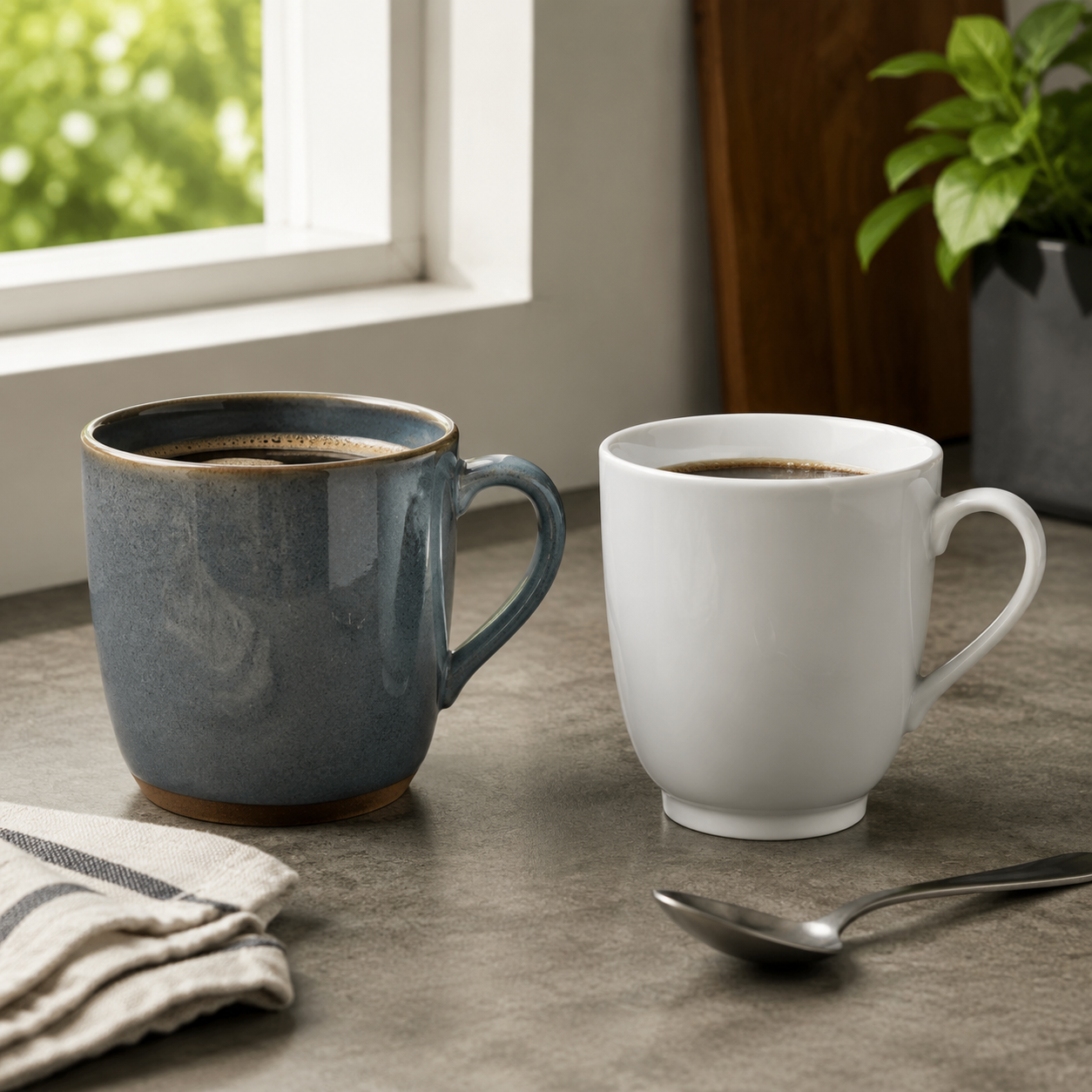
Set a thick-walled mug beside a fine white cup on a kitchen counter and the difference looks obvious. Pick them up, pour in hot coffee, and run them through everyday use, however, and the decision becomes less simple. Buyers comparing ceramic vs porcelain coffee mugs need to look beyond color and surface shine. Rim thickness, total weight, handle clearance, glaze quality, capacity, and care instructions often matter more than the material label alone.
We handle mug questions from shoppers who want something comfortable at an office desk, presentable in a gift box, or dependable for repeated coffee and tea service. Our practical advice is to separate general material behavior from product-specific facts. A product name or photo does not prove its capacity, firing method, dimensions, or dishwasher compatibility, so those details should always be confirmed on the individual listing.
What does ceramic mean next to porcelain on a product page?
Ceramic is a broad material family that includes earthenware, stoneware, and porcelain. In retail listings, though, ceramic often refers to a non-porcelain clay body, commonly one with a more substantial look and feel. Porcelain is typically made from a finer, more refined clay mixture and fired until the body becomes highly vitrified. It is still ceramic, but shoppers usually see it treated as a separate category.
| Buyer variable | Non-porcelain ceramic mug | Porcelain mug |
|---|---|---|
| Typical hand feel | Often thicker and more substantial | Often finer and lighter at a similar size |
| Rim profile | Commonly rounded or visibly thick | Can be made thinner and more refined |
| Appearance | Wide range of glazes, textures, and clay colors | Frequently smooth, bright, and visually crisp |
| Everyday risk | Added thickness can increase weight | A fine rim may be vulnerable to edge impacts |
| Best reason to choose it | You prefer a grounded, substantial mug | You prefer a lighter, refined cup |
These are tendencies, not guarantees. A thick porcelain mug may outweigh a small stoneware mug, while a poorly balanced ceramic handle can make a modest cup feel tiring. Start with the material family, then compare the actual listing photos and specifications in our unique coffee mugs collection.
Ceramic vs porcelain coffee mugs: which feels better in the hand?
Hand feel is where the comparison becomes personal. We check four areas before calling any mug comfortable:
- Rim thickness: A rounded, thicker rim can feel casual and sturdy. A thinner porcelain rim may feel more precise for sipping tea or black coffee, but it gives you less material at the edge to absorb a knock.
- Weight balance: The handle should not pull the mug sideways when it is empty. Remember that the drink adds weight, so an already heavy mug may become awkward when filled.
- Handle clearance: Compare the opening with your usual grip. A decorative handle can look appealing but still crowd larger fingers or force a two-finger hold.
- Exterior texture: Raised details can improve tactile grip, but deep grooves may take more attention to clean than a smooth glazed wall.
If a familiar rounded form is your starting point, inspect the Round Coffee Tea Mug and use its listing to confirm the exact material, dimensions, capacity, and care information. The silhouette can help narrow your choice, but it should not substitute for those specifications.
Which material suits office desks, gift boxes, tea, and iced coffee?
A mug that works on a quiet kitchen counter may be a poor fit for a crowded desk. Match the choice to the situation rather than assuming one material is universally better.
- Office desk: Prioritize a stable foot, a comfortable handle, and a size that leaves room around your keyboard. A substantial ceramic mug may feel secure, but excess weight can be tiring. Fine porcelain is pleasant to lift, although a thin rim is not ideal where phones, pens, or other cups regularly strike it.
- Gift unboxing: Shape, glaze, and decorative detail create the first impression. Care instructions still matter. A recipient without a dishwasher may accept hand-washing, while someone buying for a busy shared kitchen may not.
- Tea service: A fine rim can suit smaller, measured sips, and a light or white interior makes the color of tea easier to see. That visual benefit depends on the actual interior finish, not merely the word porcelain.
- Milk drinks: Capacity and usable headroom matter more than the ceramic category. Leave space for foam instead of choosing solely by the capacity measured to the brim.
- Iced coffee: Check how much room remains after adding ice. Neither ceramic nor porcelain replaces a sealed travel tumbler, and an open mug is a poor choice for commuting or carrying inside a bag.
For rough handling, outdoor use, or a daily train commute, a lidded insulated cup may suit you better than either option. That limitation is easy to overlook when decorative mugs are being compared only by appearance.
How can you spot rim, glaze, handle, and base problems?
Material names do not protect a mug from weak finishing. In our experience, close product photos and a careful inspection after delivery reveal more than broad claims about durability.
- Trace the rim: Look for chips, rough glaze, flat spots, or an uneven drinking edge. The lip should feel smooth all the way around.
- Inspect both handle joins: Hairline cracks often begin where the handle meets the body. Also check for glaze gaps or sharp transitions that press into a finger.
- Set the mug on a flat counter: A poorly finished foot ring may cause rocking. An exposed ceramic foot should also be smooth enough that it does not scratch a desk or table.
- Study the glaze: Pinholes are tiny pits, crawling leaves areas where glaze has pulled away, and crazing appears as a network of fine lines. Crazing can be intentional on some decorative ware, so do not assume it is either a defect or a feature without confirmation from the listing.
- Check height and diameter: Compare both measurements with your cabinet shelf, coffee machine clearance, cup warmer, or storage rack. Capacity alone does not tell you whether the mug will fit.
- Confirm usable capacity: A brim-full measurement leaves no practical room for walking, stirring, milk, foam, or ice. Your normal fill level will be lower.
Which CoffeifyMug style page matches your buying situation?
Our product pages should be used for their listed details and current photos. The recommendations below are based on the style direction named by each product, not on unlisted assumptions about material or care.
- You want a familiar everyday outline: Start with the Round Coffee Tea Mug. A round profile is a practical visual starting point for buyers who prefer a recognizable coffee or tea shape. Confirm the listing specifications before deciding whether it fits your grip and serving size.
- You want exterior detail for a gift or open shelf: Review the Pleated Coffee Tea Cup. The pleated design cue makes it relevant to shoppers comparing surface detail. Use the photos to judge the depth of the pattern and consider how easily that exterior will wipe clean.
- You want the decoration to carry the gift: Inspect the Landscape Coffee Tea Mug. It is the more direct page to check when a landscape theme suits the recipient or kitchen. Verify the pictured design, material, and care directions on the page rather than relying on the name alone.
- You are still comparing shapes: Scan the unique coffee mugs collection in separate browser tabs. Compare rim, handle, base, and dimensions in the same order for each candidate.
How do capacity and care rules change the decision?
Capacity can outweigh the material choice. A small porcelain cup may suit short coffee or tea service, while a larger ceramic mug may suit milk drinks or a longer desk session. The trade-off is filled weight. If size is already part of your decision, our 12 oz ceramic mug fit and care guide, 16 ounce ceramic mug ordering guide, and 20 oz ceramic mug buyer guide explain the practical differences between common size categories. Those guides do not establish the capacity of any product linked above; use each product listing for that.
Care compatibility must also be confirmed rather than assumed. Use this routine:
- Read the product page for explicit dishwasher and microwave directions.
- Avoid pouring boiling liquid into a mug that is refrigerator-cold; sudden temperature changes can stress ceramic bodies and glazes.
- In a dishwasher, position mugs so their rims and handles cannot strike other pieces during the cycle.
- Do not microwave metallic decoration, and do not treat an unmarked mug as microwave-safe.
- Retire a mug from drink service if a chip creates a sharp rim or a crack develops through the body.
What should you confirm before placing the order?
- The listing identifies the material clearly.
- The stated capacity leaves room for milk, foam, stirring, or ice.
- The height and diameter fit your shelf and coffee setup.
- The rim and handle match your preferred grip.
- The care directions fit your actual washing routine.
- The design suits the kitchen, office, or gift recipient.
- You are buying an open mug for stationary use, not expecting it to perform like a sealed travel cup.
If two mugs still look equal, prioritize the one with clearer specifications and care instructions. A transparent listing gives you a better buying basis than a broad claim that one material is always stronger, lighter, or better at holding heat.
Frequently asked questions
Do ceramic vs porcelain coffee mugs keep coffee hot longer?
The material name alone does not predict heat retention. Wall thickness, total mass, mug shape, starting temperature, and whether you preheat the cup all affect how quickly a drink cools. A thick ceramic mug may retain heat well after warming, but it can also absorb more heat from the first pour if it begins cold.
Is porcelain too fragile for everyday coffee?
Not automatically. Porcelain can have a hard, highly vitrified body, but a thin rim or delicate handle can still chip after an edge impact. Inspect the actual mug construction and treat fine pieces with more care in crowded sinks and dishwashers.
Can ceramic and porcelain mugs both go in the microwave and dishwasher?
Some can, but compatibility is not guaranteed by either material label. Glaze, decoration, metallic accents, and construction all matter. Follow the exact care directions on the product page and contact the store before ordering if those directions are unclear.
Where should I start comparing CoffeifyMug styles?
Begin with the unique coffee mugs collection, choose two or three shapes, and compare their listing details side by side. Check material, capacity, dimensions, handle clearance, care instructions, and intended use before selecting the design you prefer.
Read more

Coffee Mug Birthday Gift Ideas for Different Daily Routines
Match a birthday mug to the recipient's drink routine, kitchen or desk setup, care tolerance, and personal style. This guide compares practical fit checks and three distinct CoffeifyMug designs.
Leer más
Are Ceramic Coffee Mugs Safe? Buyer Checks Before You Order
Ceramic mugs are usually a practical choice for coffee and tea, but safety depends on glaze condition, seller specifications, care limits, and how the mug will be used day after day.
Leer más
Dejar un comentario
Este sitio está protegido por hCaptcha y se aplican la Política de privacidad de hCaptcha y los Términos del servicio.