
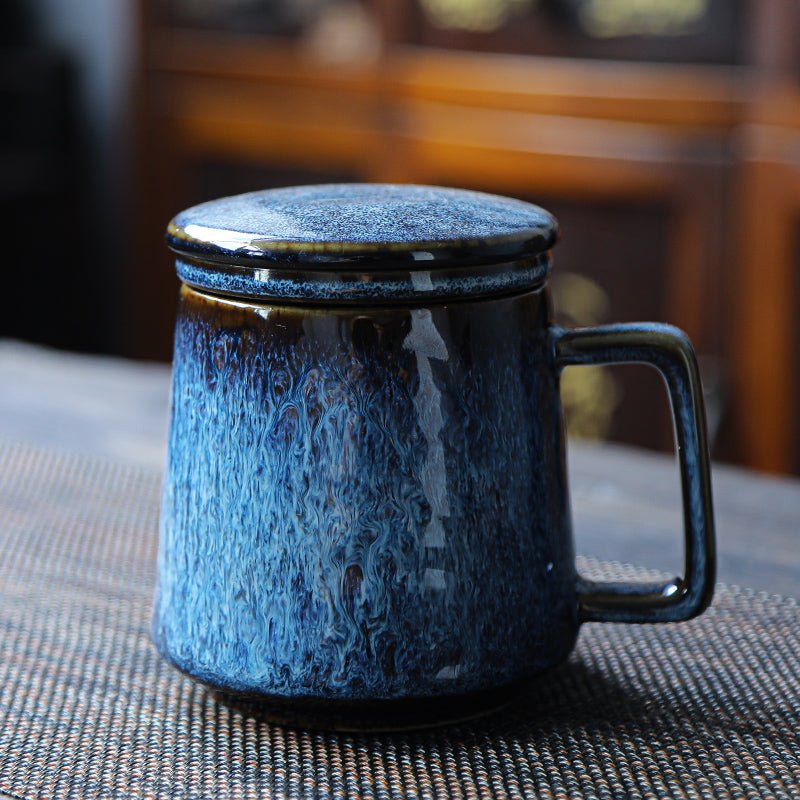
Abstract Coffee Mug Daily Use Guide: 250 ml or 400 ml?
Reading time: about 10 minutes
A 400 ml mug can look perfectly reasonable on a product page, then crowd the space below a compact coffee machine or hold far more coffee than you normally finish. A 250 ml mug creates the opposite problem if your usual drink includes plenty of milk or ice. This abstract coffee mug daily use guide starts with that daily mismatch, because visual appeal matters only if the mug also suits the drink, desk, cupboard, and cleaning routine around it.
In our store, capacity is the practical detail we ask about first. The verified catalog facts give us three distinct options: Rhombus has a 250 ml capacity and geometric form, while Gradient and The Flow each hold 400 ml. Gradient is identified by its color-transition finish, and The Flow by sculptural curves. We treat abstract as a style description, not as proof of a creator, named art movement, production technique, or design provenance.
250 ml or 400 ml: which capacity fits your normal serving?
The difference between 250 ml and 400 ml is 150 ml. That is enough to change how a mug works during breakfast, a meeting, or an afternoon tea break. Capacity is not an exterior dimension, though, and a listed capacity should not automatically be treated as a comfortable fill line. Most people need visible headspace to carry a hot drink without spilling it.
- Choose 250 ml for shorter servings: The Rhombus Coffee and Tea Mug fits someone who usually makes a compact coffee or tea and wants the geometric form to be the visual focus. It is not the best fit for a large milk-based drink, a long tea steep, or a serving that needs substantial room for ice.
- Choose 400 ml when finish is the priority: The Gradient Coffee and Tea Mug gives you the larger verified capacity with a color-transition finish. It suits a shopper who wants more drink volume and a noticeable surface treatment. It is less suitable if you prefer a restrained, uniform exterior or regularly leave larger servings unfinished.
- Choose 400 ml when form is the priority: The Flow Coffee and Tea Mug pairs the larger capacity with sculptural curves. It makes sense for someone who values a shaped silhouette as much as serving volume. A simpler form may be more practical if your cupboard is tightly packed or you want the most predictable fit in a standard mug slot.
| Model | Verified catalog detail | Daily-use match | Reason to choose another style |
|---|---|---|---|
| Rhombus | 250 ml, geometric form | Short coffee or tea servings and shoppers who prefer a smaller nominal capacity | Your regular recipe is close to 250 ml before leaving carrying room |
| Gradient | 400 ml, color-transition finish | Larger drinks where the exterior color treatment is part of the appeal | You want a plain finish or a smaller serving |
| The Flow | 400 ml, sculptural curves | Larger drinks and shoppers drawn to a shaped silhouette | You need confirmed exterior dimensions for a very tight storage space |
If none of those descriptions settles the decision, compare the product photography and current specifications across our unique coffee mugs collection. Look beyond capacity: overall height, maximum width, rim shape, base footprint, and handle clearance can determine whether a mug works in your particular kitchen.
Our abstract coffee mug daily use guide: what changes between geometric, gradient, and curved forms?
Geometric form, color transition, and sculptural curves describe different visual priorities. They do not tell you the mug's body material, wall thickness, weight, dishwasher status, microwave compatibility, or exterior dimensions. Those are separate specifications. From handling display mugs and helping shoppers compare decorative options, we have found that the missed detail is often something ordinary: finger clearance, shelf height, or how closely mugs sit beside one another.
- Check the rim in the product images. A rim should suit the way you drink, but do not infer its thickness from the overall style name.
- Look at the grip area. If the design includes a handle, compare its opening with mugs you already find comfortable. Capacity alone says nothing about finger room.
- Inspect the base footprint. A broad-looking body can still have a smaller contact area. Confirm the available views instead of assuming stability from the silhouette.
- Measure the intended storage spot. Record shelf height and usable width, including space needed to lift the mug out without striking the shelf above.
- Check appliance clearance. Measure from your brewer's drip tray to its outlet if you plan to fill the mug directly under the machine.
The Rhombus description confirms a geometric form, but it does not establish every angle, measurement, or grip characteristic. The same boundary applies to The Flow's sculptural curves. Gradient's finish tells you what creates its visual effect, not how the material should be heated or cleaned. We recommend using the current product listing and care information for those decisions.
Coffee, tea, or iced drinks: where does each size make sense?
Start with the volume of the finished drink, not the label on the recipe. Coffee, milk, foam, tea leaves, an infuser, and ice all occupy space. Pour your normal drink into a measuring vessel once. That quick check is more reliable than choosing a mug because its capacity sounds familiar.
- Compact coffee: A 250 ml Rhombus can suit a shorter coffee with room left below the rim, provided the finished recipe stays comfortably under the mug's listed capacity. Shoppers working in the 170 ml to 270 ml range can compare serving logic in our cappuccino coffee mug daily-use guide.
- Long coffee or milk-based drink: The 400 ml Gradient or The Flow gives a larger volume allowance. That can reduce the need to fill to the brim, but it may also encourage a serving that cools before you finish it. Heat retention depends on material, wall construction, starting temperature, and environment, none of which should be inferred from capacity alone.
- Tea: Either capacity can work. A 250 ml mug favors shorter pours, while 400 ml gives more room for water and an infuser. Confirm that the infuser fits the opening and leaves enough headspace; our loose-leaf tea mug guide for 250 ml, 390 ml, and 400 ml covers that setup in more detail.
- Iced coffee: Ice displaces liquid, so 400 ml offers more total room than 250 ml. Before exposing any mug to sharp temperature changes, check its stated material and care directions. A decorative coffee mug should not be assumed to tolerate every hot-to-cold transition.
For a realistic kitchen test, measure the complete recipe and then add the amount of empty space you need for carrying it from counter to desk. If the total approaches 250 ml, Rhombus is probably too tight. If your normal serving is much smaller, a 400 ml mug may feel visually oversized even though it technically works.
How should an abstract finish or sculptural form be cleaned?
We cannot confirm dishwasher or microwave compatibility from the supplied style and capacity facts alone. Abstract, geometric, gradient, and sculptural are not care ratings. Check the current product page, packaging, or included care directions before the first dishwasher cycle or microwave use, and follow those instructions if they differ from general care advice.
- Inspect before washing. Check the rim, body, base, and any handle attachment for a chip, hairline crack, or looseness.
- Use a conservative first wash. Mild dish soap, warm water, and a soft sponge reduce unnecessary abrasion while you confirm product-specific directions.
- Avoid abrasive pads on decorative surfaces. Repeated hard scrubbing can dull or mark some finishes. This is a general precaution, not a claim about the production method of these three mugs.
- Prevent contact in the dishwasher if machine washing is allowed. Place the mug where it cannot knock against plates or another mug during the cycle.
- Avoid abrupt temperature changes unless explicitly permitted. Do not move a very hot mug straight onto a cold or wet surface, or pour boiling liquid into a chilled mug, without care guidance confirming that use.
Retire a mug from drink service if you find a crack, a sharp rim chip, or movement at a handle joint. On a glazed mug, fine surface lines can also warrant checking the manufacturer's guidance before continued use. These checks take seconds at the sink and matter more than trying to keep a decorative mug looking untouched.
Will the mug work at a desk, under a brewer, and in a cupboard?
A useful abstract coffee mug daily use guide has to account for the spaces around the mug. A design can be comfortable at the breakfast table and inconvenient beside a keyboard. Before ordering, use one of your current mugs as a physical reference and write down the dimensions that already work.
- Office desk: Check that the intended coaster supports the full base and that your usual placement keeps the mug away from cables and the edge of the desk.
- Compact brewer: Capacity does not reveal height. Measure the vertical clearance and leave enough room to angle the mug in and out without catching the outlet.
- Kitchen cupboard: Sculptural or geometric shapes may use shelf width differently from straight-sided mugs. Use the listed dimensions and product views rather than relying on the 250 ml or 400 ml figure.
- Dishwasher rack: Confirm machine-wash approval first, then check that the mug can sit securely without its rim or exterior contacting nearby items.
- Car or commute: Do not assume any of these products is insulated, lidded, leak-resistant, or sized for a vehicle cup holder. Choose a verified travel mug if spill control is the main requirement.
The last point is a common boundary. A striking 400 ml mug can be a good stationary desk mug, but larger capacity does not turn it into travel drinkware. Likewise, a 250 ml mug is not automatically cup-holder compatible simply because it holds less.
Which abstract style makes the most useful gift?
Gift decisions are easier when you match the recipient's routine before matching decor. Picture the unboxing, but also picture the following Monday morning: the mug needs to fit their drink, storage, and cleaning habits after the novelty of the shape has passed.
- For someone who makes shorter drinks: Rhombus offers the verified 250 ml capacity and a geometric form. Skip it if the recipient usually carries a large coffee into a long meeting.
- For someone who responds to color: Gradient combines a 400 ml capacity with a color-transition finish. A plain mug is safer if you do not know their color preferences.
- For someone who displays distinctive forms: The Flow uses sculptural curves and holds 400 ml. Choose a simpler silhouette if the recipient has crowded shelves or strongly practical tastes.
Do not describe any of these as artist-designed, handmade, limited edition, or connected to a named art movement unless the current product information explicitly verifies that claim. Abstract is the shopper's style lens here. For more routine-based gift checks, see our coffee mug gift idea daily-use guide.
Frequently asked questions
Is a 250 ml abstract coffee mug too small for daily coffee?
It is too small if your finished drink approaches 250 ml before you leave carrying room below the rim. It can be a practical size for shorter coffee or tea servings, making the 250 ml Rhombus the relevant option among these three. Measure coffee, milk, and foam together before deciding.
What is the practical difference between Gradient and The Flow?
Both have a verified 400 ml capacity, so the documented distinction is visual. Gradient has a color-transition finish, while The Flow has sculptural curves. Choose based on finish versus form, then check current dimensions and care instructions for the practical details not established by those descriptions.
What should an abstract coffee mug daily use guide check before dishwasher use?
It should check the product's explicit dishwasher directions, the condition of the rim and body, and whether the mug can sit without knocking into other items. The style name and capacity do not prove dishwasher compatibility. If the instructions are unavailable, hand washing with mild soap and a soft sponge is the conservative choice.
Are these abstract mugs connected to a particular artist or art movement?
No creator attribution, institutional provenance, named art movement, edition status, or production method is established by the verified facts used here. Rhombus, Gradient, and The Flow should be compared as style and capacity options. Rely only on explicit product information for any stronger provenance claim.
Which abstract coffee mug should I choose first?
Choose Rhombus if a 250 ml serving and geometric form match your routine; choose Gradient if you want 400 ml and a color-transition finish; choose The Flow if you want 400 ml with sculptural curves. Before adding one to your cart, measure your normal finished drink, brewer clearance, and cupboard space, then confirm care instructions. If the visual direction is still open, compare those details in the unique coffee mugs collection.
Read more
Breakfast Coffee Cup Daily Use Guide: 170, 200, or 350 ml?
Compare CoffeifyMug's 170 ml Retro, 200 ml Pleated, and 350 ml Landscape Tall options by breakfast-table space, refill habits, drink style, and daily care. See where each cup fits and where it does...
Leer más
Matcha Latte Mug Daily Use Guide: 250 ml, 390 ml, or 400 ml?
Compare 250 ml, 390 ml, and 400 ml matcha latte mugs using measured serving size, visible opening shape, counter space, refill habits, and practical care checks.
Leer más
Dejar un comentario
Este sitio está protegido por hCaptcha y se aplican la Política de privacidad de hCaptcha y los Términos del servicio.