
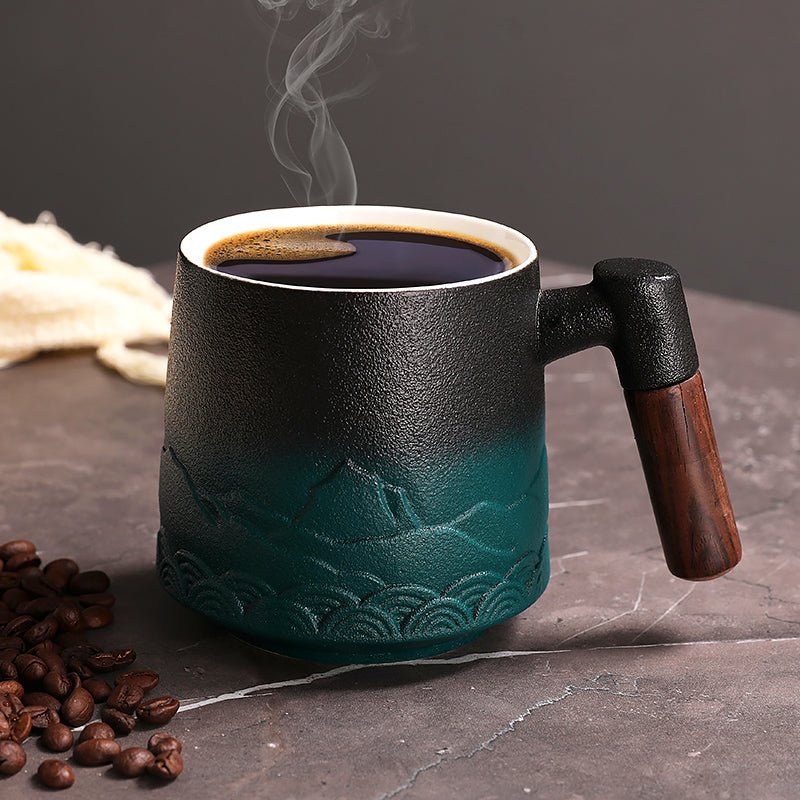
Clay Pottery Coffee Mugs Capacity Guide: 200, 270 & 350 ml
Reading time: about 9 minutes
A mug that looks right on a product page can feel surprisingly small after you add milk, or unnecessarily large once it sits half-finished on an office desk. We see this capacity mismatch often in our store. This clay pottery coffee mugs capacity guide compares the listed 200, 270, and 350 ml sizes by actual serving routine, refill pattern, and the amount of room a drink needs above the liquid.
The goal is not to declare one capacity universally better. A 200 ml pottery mug suits a compact coffee break, while a 350 ml mug makes more sense for a longer pour. The middle 270 ml size is usually the easiest compromise, but it still will not suit every drink or counter setup.
Clay pottery coffee mugs capacity guide: what do 200, 270, and 350 ml mean?
Milliliters are more useful than vague labels such as small, regular, or large. The three listed capacities convert to approximately 6.8, 9.1, and 11.8 US fluid ounces. Those figures describe total volume, not necessarily the amount most people will pour during daily use.
| Listed capacity | Approximate US volume | Comfortable routine | Main trade-off |
|---|---|---|---|
| 200 ml | 6.8 fl oz | Short coffee, small tea, controlled portions | Limited room for milk, foam, or ice |
| 270 ml | 9.1 fl oz | Standard home coffee, Americano, tea | May still feel small for a long desk drink |
| 350 ml | 11.8 fl oz | Larger coffee, milk drink, extended tea break | Drink may cool before a slow sipper finishes |
For daily planning, leave some headspace rather than filling a mug to the rim. Around 15 to 30 ml of open space helps reduce spills while walking from the kitchen counter to a desk and leaves room for milk or stirring. That headspace is general serving guidance, not a separate capacity claim for the linked products.
Which capacity matches your refill pattern?
Capacity changes more than the size of the first pour. It affects how often you return to the kettle or coffee maker, how long the drink sits, and how much liquid is likely to be left behind.
- Choose 200 ml for short, deliberate servings. It fits someone who drinks coffee promptly, prefers a smaller portion, or likes to refresh a drink rather than let a large mug sit. It is not a strong fit for an iced drink or a milk-heavy latte because additions use the available volume quickly.
- Choose 270 ml for a familiar everyday cup. It provides more breathing room than a compact cup without creating an oversized serving. This is the practical middle ground for a morning coffee, a moderate Americano, or loose-leaf tea served without filling to the rim.
- Choose 350 ml for fewer refills. The larger volume works at a desk, during breakfast, or for a drink with a meaningful amount of milk. The trade-off is temperature: a slow drinker may reach the cooler final third before finishing.
Think about what you already pour, not the capacity you imagine you might use. If your coffee maker dispenses a known volume, compare that amount with the mug capacity and reserve room for anything added afterward.
Which current pottery mug fits each serving routine?
Our current comparison set covers three distinct serving sizes. The product pages should remain the final reference for available variants and current product details before ordering.
200 ml for a compact coffee or tea break
The Mountain Sea Coffee Tea Mug is the place to start for the compact 200 ml routine. It fits a shopper who wants a smaller clay pottery mug for a concentrated morning pour or a fresh cup of tea that will be finished before it cools. Its capacity is less suitable if you regularly add a large amount of steamed milk, foam, or ice.
270 ml for a balanced everyday pour
The Great Mountain Coffee Tea Mug matches the 270 ml middle position in this comparison. Choose it if a 200 ml mug sounds restrictive but a 350 ml serving would often go unfinished. The added volume gives you more working room for milk or stirring while keeping the mug aligned with a conventional single-cup routine.
350 ml for a longer drink at breakfast or a desk
The Landscape Coffee Tea Mug suits the larger 350 ml routine. It is the stronger fit for someone who wants fewer refills or regularly prepares a longer coffee or tea. It is not the best choice for a person who prefers small, piping-hot servings and drinks slowly.
If visual design matters as much as capacity, compare these options with the wider unique coffee mugs collection. Check the selected variant and listed volume on the product page before adding a mug to your cart, since availability and selections can change.
How much usable room should you leave below the rim?
A listed 270 ml mug does not mean every drink should contain exactly 270 ml. Filling to the top makes stirring awkward and increases the chance of coffee running down the outer glaze. We use a simple planning approach when helping shoppers compare sizes:
- Start with the volume produced by your brewer, kettle routine, or usual measuring cup.
- Add the milk, cream, foam, or other additions you normally use.
- Reserve roughly 15 to 30 ml for carrying and stirring.
- Move up one capacity if the total is too close to the listed rim volume.
Using that method, a 200 ml mug is most comfortable with a pour below its full capacity. The same rule applies to 270 and 350 ml mugs. Buyers who already know they prefer a traditional 12-ounce format can compare the larger end of this range with our 12 oz ceramic coffee mugs capacity guide.
Does clay pottery construction change the size decision?
Capacity alone does not tell you wall thickness, handle clearance, overall weight, or how a particular glaze feels in the hand. These are separate product variables. Two ceramic mugs with the same listed volume can have different external proportions because one has straighter walls while another uses a wider body or thicker construction.
That distinction matters in a crowded cupboard and on a compact desk. A wide-bodied mug can occupy more surface space, while a taller shape may be harder to place under some coffee machines. The linked product pages are the correct place to confirm any listed dimensions and care details; do not infer them from capacity alone.
Pottery and ceramic surfaces also deserve practical inspection when a mug arrives. Before first use, check the rim for chips, look around the handle joins for visible cracks, and inspect the glazed interior for damage from transit. Decorative variation should not be confused with a structural defect, but a sharp rim chip or cracked handle is not something to ignore.
If base width and counter stability are central to your decision, our ceramic wide bottom coffee mugs capacity guide addresses that variable more directly than capacity alone.
Where do these three sizes become a poor fit?
All three mugs are intended for ordinary coffee and tea routines, but capacity limits still matter. A realistic comparison includes the situations where another format is more useful.
- Iced coffee: Ice displaces liquid. Even 350 ml can feel compact once several cubes, coffee, and milk share the same mug. A larger vessel may suit this routine better.
- Large cafe-style milk drinks: A 200 ml mug leaves little room for a long shot, steamed milk, and foam. Consider 270 or 350 ml, depending on your recipe.
- Very short espresso servings: All three can hold the drink, but the open space in a larger mug may feel out of proportion. A dedicated espresso cup is the more natural choice.
- Long heat retention: Capacity does not guarantee insulation. If you need a drink to stay hot for an extended commute, a covered insulated vessel will generally suit the task better than an open pottery mug.
- Strict microwave or dishwasher requirements: Do not assume compatibility from the ceramic appearance. Follow the care information stated on the individual product page.
What care routine protects a glazed pottery mug?
Care instructions on the product page take priority. As a general handling routine, allow a very hot mug to cool before exposing it to cold rinse water, use a non-abrasive sponge on decorated or glazed areas, and avoid metal scouring pads that can mark the surface. Sudden temperature changes can stress ceramic materials, so moving a cold mug directly into extreme heat is not a sensible shortcut.
After washing, check the rim and handle periodically. Common damage points in everyday use are rim chips from contact with other dishes, cracks near handle joins, and surface marks caused by abrasive cleaning. Stop using a mug if a crack becomes structural or the drinking rim develops a sharp edge.
Use this 30-second capacity checklist before ordering
- Pick 200 ml if you finish small coffee or tea servings quickly and do not need much room for additions.
- Pick 270 ml if you want one moderate daily cup with practical stirring space.
- Pick 350 ml if you prefer a longer drink, add milk, or want fewer kitchen refills.
- Allow 15 to 30 ml of headspace in your planning rather than treating listed capacity as the ideal fill line.
- Check the product page for the selected capacity, dimensions, availability, and stated care guidance before checkout.
Frequently asked questions
What size clay pottery coffee mug is best for one daily coffee?
Use this clay pottery coffee mugs capacity guide as a starting point: 270 ml is the balanced option for a moderate everyday pour, while 350 ml suits a longer drink. Choose 200 ml if you prefer a smaller serving that you can finish while it is still hot.
Is a 200 ml pottery mug large enough for coffee with milk?
It can be, provided the brewed coffee portion is small and you leave room for the milk. It is not a practical choice for a large latte-style recipe; a 270 or 350 ml mug gives you more usable headspace.
How many ounces are 270 ml and 350 ml?
A 270 ml capacity is approximately 9.1 US fluid ounces, while 350 ml is approximately 11.8 US fluid ounces. Treat those as volume conversions, not recommended fill lines, because a comfortable pour should stop below the rim.
Should I buy the largest mug to avoid refills?
Only if you usually finish a larger serving. A 350 ml mug reduces refill trips, but coffee can cool if you drink slowly; in that situation, a fresh 200 or 270 ml refill may be more enjoyable.
Where can I compare other clay pottery mug designs?
Start with the unique coffee mugs collection, then check each product page for its listed capacity and current options. Match your normal pour plus additions and headspace to the closest available size before ordering.
More from our blog
Read more
Apple Cider Mug Capacity Guide: 400 ml vs 480 ml
Compare CoffeifyMug's current 400 ml and 480 ml ceramic mugs by serving routine, refill frequency, handle fit, desk space, and everyday care.
Read more
Two Tone Ceramic Coffee Mugs Capacity Guide: 400-480 ml
Compare CoffeifyMug's current 400, 440, and 480 ml two-tone ceramic mugs by serving routine, refill frequency, desk use, and practical carrying comfort.
Read more
Los kommentaar
This site is protected by hCaptcha and the hCaptcha Privacy Policy and Terms of Service apply.